
Environment

Mapping Climate Risks by County and Community

by Ari Pinkus February 17, 2021

With the Biden administration elevating climate change concerns to the national agenda, the American Communities Project leveraged data from Four Twenty Seven, a physical climate risk data firm and affiliate of Moody’s, to understand how the risks manifest by ACP type — and where populations and infrastructure may be especially vulnerable.

Four Twenty Seven analyzes several physical risks to the U.S. landscape, including sea level rise; hurricanes; extreme rainfall; water stress; and heat stress, characterized by higher temperatures. Many of Four Twenty Seven’s projections through 2040 show the risks are regional, as illustrated in maps below. We also parse the degree to which high risks differ by ACP type. Six key takeaways emerge from filtering:

  1. Sea level rise stands out as a climate hazard in Military Posts, based on the percentage of these counties affected compared with the ACP’s 14 other community types.
  2. The threat of hurricanes hangs over a clear majority of African American South counties, where the populations tend to have lower incomes and less higher education experience. No other community type reaches the 50% threshold, though Military Posts come close.
  3. Extreme rainfall is also expected in a majority of counties in the African American South as well as mostly-white Working Class County and blue-collar Middle Suburbs. When it comes to the African American South’s two big climate risks, many Black homeowners and renters, in particular, live in low-lying areas and lack flood insurance, making them more vulnerable. In Middle Suburbs, where the manufacturing sector has been hit hard by globalization these past 30 years, intense floods could pose additional economic harm, negatively impacting industry and transportation into the future.
  4. More than three-quarters of two rural community types with young populations — Hispanic Centers and LDS Enclaves — expect to experience significant drought conditions in the coming years. This may be especially harmful in Hispanic Centers, where agriculture is a key industry and heavily dependent on water availability.
  5. Heat stress is forecast in a majority of Evangelical Hubs, i.e. lower-income, less educated, and less diverse communities with a large number of Evangelical adherents, located in the Midwest and South. That education and income are the strongest socioeconomic drivers of health effects from heat may make Evangelical communities more sensitive to absorbing these perils.
  6. Among the 47 Big City counties, all five physical risks are notable, with hurricanes, water stress, and heat stress the most prevalent by percentage. For these stratified, diverse communities, populations are likely to be unevenly affected by the hazards.

Where East Meets West: Rising Seas

It’s unsurprising that sea level rise presents the greatest threat to populations living along the U.S. coastline — most of the country’s geography is in no danger of rising seas. There are several zones to watch. The mid-Atlantic region into the upper South — from New Jersey to North Carolina — contains a dozen counties deemed red flag for their significant exposure of coastal flooding. These counties have a combined population of 863,519, based on U.S. Census estimates in 2019. South Florida and counties in Louisiana, Mississippi, and Texas ringing the Gulf of Mexico are red flag or high risk. A few patches of the Alaskan coastline, too, are in the red flag zone. The Pacific Northwest holds about a dozen counties with a high risk of sea level rise. (Scroll over the map to see a county’s risk level and community type designation.)

As mentioned above, rising sea levels are a great danger in Military Posts. Of the 89 counties, 19% are dubbed red flag or high risk. According to a Union of Concerned Scientists’ report in 2016, “The military is at risk of losing land where vital infrastructure, training and testing grounds, and housing for thousands of its personnel currently exist.” This could have a real impact on military readiness by reducing operational capacity.

Communities of color and diverse, densely populated places are also in the line of danger. For the 43 Native American Lands, the 370 African American South counties, and the 47 Big Cities, the numbers are 14%, 13%, and 13%, respectively. Many non-white households living near the coasts, particularly in the African American South and Big Cities, haven’t received sufficient flood investment protection and don’t have flood insurance. Four Twenty Seven explored the link between race and climate change in a piece in July 2020. Meanwhile, 12% of Urban Suburban counties face red flag or high risk.

The Dividing Line for Hurricanes

More of the U.S. population faces the danger of hurricanes. Consider that the entire coastlines of the Carolinas, much of Florida as well as the Louisiana and Alabama coastlines are deemed red flags. Beyond those red zones, the risk is high in all the states along the eastern seaboard and the Gulf of Mexico. Hurricanes are low or no risk moving westward. (Scroll over the map to see a county’s risk level and community type designation.)

As we’ve seen in recent years, hurricanes can wreak havoc on the regional infrastructure, impeding a community’s recovery. In the article “The Effects of Infrastructure Service Disruptions and Socio-Economic Vulnerability on Hurricane Recovery,” the author-researchers surveyed nearly 1,000 households in Florida after Hurricane Irma and found “that physical damage to property, disruption of infrastructure services such as loss of electric power and cell phone/internet services and other factors (i.e., homeowner’s or renter’s insurance coverage, receiving disaster assistance and loss of income) are significant predictors of post-disaster recovery when controlling for age and race/ethnicity.”

Drilling down, hurricanes are of the greatest risk in many densely populated and diverse places. In this rich mosaic, the standout is the African American South, with 64% of counties at red flag or high risk, and where populations are vulnerable because of housing conditions. Two other community types see close to half of their counties in the danger zone: 48% of Military Posts and 45% of Urban Suburbs face red flag or high risk of hurricanes. The same is true of more than a quarter of Big Cities.

Appalachia’s Ground Zero for Extreme Rainfall

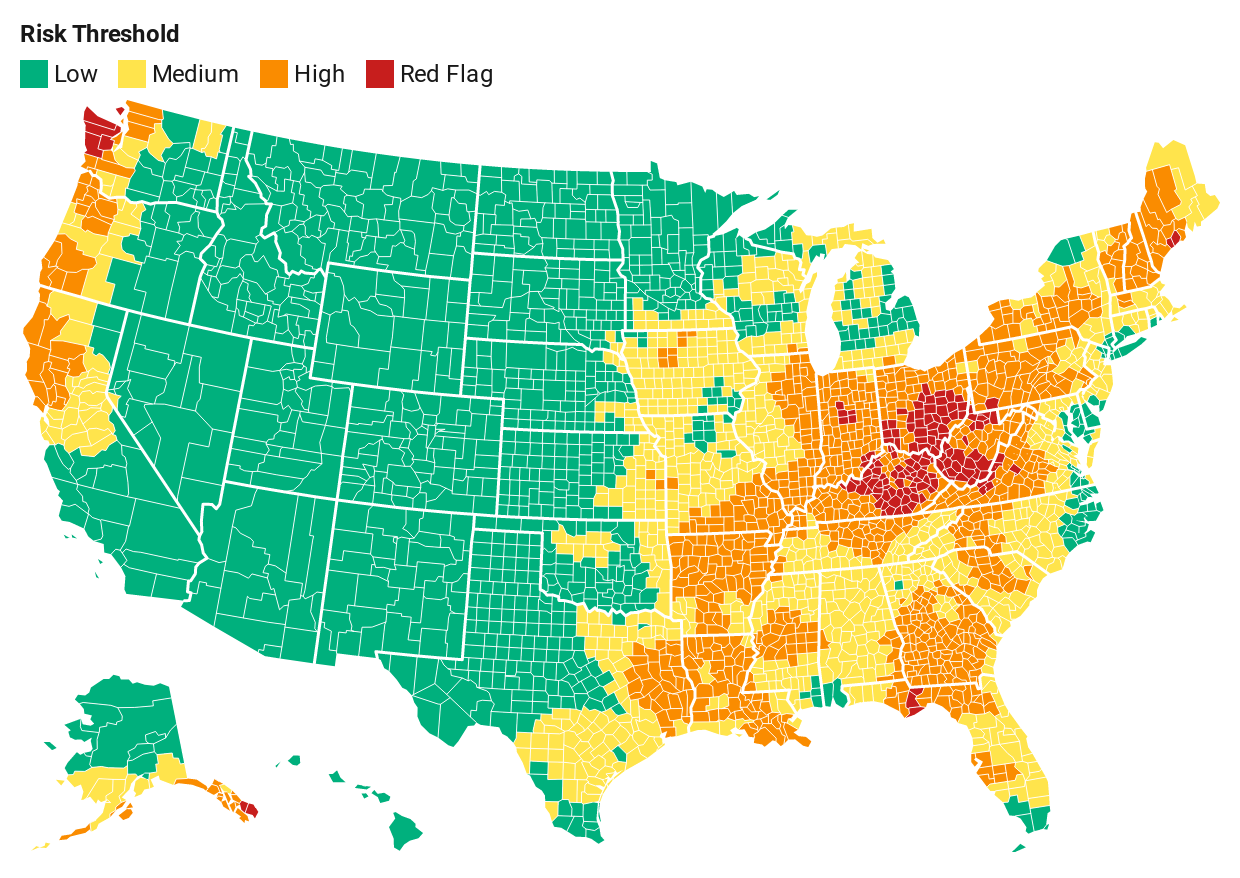
For extreme rainfall, the risk picture looks markedly different, covering more of America’s interior. The Midwest’s Ohio, Appalachia’s West Virginia and Kentucky, and Washington State’s coastline are dubbed red flag. But high risk fans out across the Midwest as well as the South, Northeast, and Pacific Northwest. In March 2020, severe weather in the Midwest and Ohio Valley, including Missouri, Ohio, Kentucky, Tennessee, West Virginia, and Pennsylvania, caused $2.6 billion in damage, according to NOAA estimates. (Scroll over the map to see a county’s risk level and community type designation.)

More intense patterns of extreme rainfall are expected to hit the Middle Suburbs particularly hard, as 62% of these 77 average-income, mostly white counties face red flag or high risk. Meanwhile, 58% of the 337 counties of Working Class Country, known for mostly white populations without much higher education, are red flag or high risk. The African American South is not far behind, with 56% of counties deemed red flag or high risk.

Drought Conditions Most Everywhere

Water stress risk covers much of America’s interior, many sparsely populated places that make up the country’s breadbasket as well as swaths of more densely populated ones, including along the East Coast. Red flags show up in many regions: a small pocket of the Midwest, chunks of the Plains, including the Ogallala Aquifer, the intermountain West, the Southwest, as well as sizable portions of California, including the Central Valley. The Department of Homeland Security reports that “water and wastewater systems, energy, and food and agriculture are the critical infrastructure sectors most vulnerable to drought conditions.” (Scroll over the map to see a county’s risk level and community type designation.)

Community types known for having younger populations are poised to experience much water stress. Of the 161 agriculture-dependent, lower-income Hispanic Centers, 85% face drought-like conditions that are considered red flag or high risk. The pattern is similar for nearly all 41 of the rural, middle-income LDS Enclaves. Of the Big City counties, 62% expect to contend with water stress deemed red flag or high. Of the 154 College Town counties, 38% are in the red flag or high risk categories.

The Midwest — Hot, Hot, Hot

More and intense hot days are red flag risks in almost all of Missouri, much of Illinois, southwestern Iowa, and a touch of Arkansas. However, most of the Midwest is in the heat zone. Risk is high for nearly half of Ohio, all of Indiana and Oklahoma, part of Wisconsin, most of Iowa, Nebraska, Kansas, Kentucky, Tennessee, and the tip of Texas. Note that humidity, an important heat stress factor for assessing heat-related health risks, is not included in Four Twenty Seven’s analysis.

Then, perhaps not surprising, the southern part of Arizona, part of the Deep South, Florida, and Hawaii are at high or red flag risk for extreme heat. (Scroll over the map to see a county’s risk level and community type designation.)

Increasing temperatures have the potential to gravely impact public health. Affected communities are home to many lower-income families that often cannot afford air-conditioning, work outdoors for a living, and/or live in difficult housing conditions. Four Twenty Seven’s white paper “Heat and Social Inequity in the United States” examines heat vulnerability in detail.

Heat waves can also take a toll on physical infrastructure, particularly in cities, and the EPA recommends protecting roads and bridges with materials that can withstand heat as well as bolstering energy efficiency to avoid power problems. Arizona, for its part, maintains a detailed extreme heat response plan.

In the Midwest and South, Evangelical Hubs are expected to bear the brunt of the heat, with 65% of its 372 counties falling into the red flag or high risk categories. Working Class Country stands at 51%, while 50% of Rural Middle America’s 599 counties, running across the country’s northern half, are deemed red flag or high risk. This has the potential to affect labor productivity because many jobs in these parts are performed outside or near machines radiating heat.

A variety of diverse and more homogeneous suburbs should expect challenges here as well, including 34% of the 77 Middle Suburbs, 32% of the 222 Exurbs, 32% of the 47 Big City counties (which often include suburbs), and 22% of the 106 Urban Suburbs.

Climate Change in Focus

The Biden administration is taking these physical risks to the U.S. seriously based on its early actions, budget, and personnel. On Inauguration Day, President Biden signed several executive orders on climate, including recommitting the U.S. to the Paris climate accord to reduce greenhouse gas emissions and adapt to the effects of climate change. Moreover, Special Presidential Envoy for Climate John Kerry and White House National Climate Advisor Gina McCarthy are putting job creation at the center of the climate agenda and taking a more focused approach to tackling environmental inequities. The administration is also raising up the issue globally, hosting a climate summit of world leaders on April 22, the 51st Earth Day.

Vol. 3 2020-2021

Deaths of Despair Across America

The American Communities Project is undertaking a 30-month study of Deaths of Despair in its 15 community types.

Learn More
Health

A Year After Covid-19’s Arrival, Sparsely Populated Communities Have Highest Case Rates

by Dante Chinni February 05, 2021

As the Covid-19 pandemic has spread across the country, its impacts on the county types of the American Communities Project have changed. The urban places that were once the biggest hot spots are not anymore. Instead, a selection of rural communities has come to dominate the “cases per 1,000 population” breakdown.

Using that measurement, the communities that have seen the highest numbers of Covid cases so far are the Native American Lands, LDS Enclaves, and Aging Farmlands. All are currently higher than 100 cases per 1,000 people, meaning they have infection rates above 10%. Nationally, the figure sits at about 78 cases per 1,000 Americans.

Those three community types hold very different kinds of populations in terms of age and race, but they share one common factor: They tend to be fairly sparsely populated. At the outset of the pandemic, that spread of population was seen as an advantage with a virus that spreads through close contact between people. Now that we’ve passed the one-year anniversary of Covid-19, the data suggest that initial theory didn’t account for many other important factors.

These numbers suggest that differences in community attitudes on issues such as masking, gatherings and, in a broader sense, politics (since Covid-19 has become politicized) likely have bigger impacts than sheer density.

The Data

The ACP compared county-level data on the total number of cases up to May 6, 2020 (the first peak of the pandemic) to county-level data on the total cases up to January 30, 2021 — and the changes are dramatic.

Back in May, Urban Suburbs had the highest number of reported cases per 1,000 population at 6.3 cases per 1,000 people. Behind these suburban communities were Big Cities and Native American Lands, both at 5.1 cases per 1,000 people. No other community was even at 4 cases per 1,000.

The most remarkable thing about the data from January 30, 2021, is the sheer increase in cases. The national figures climbed from 3.7 per 1,000 people to more than 77 per 1,000 people. The number of cases in that time went from 1.2 million to more than 25 million.

But the differences in the relative caseloads stand out. Urban Suburbs now sit below the national average. At the same time, Native American Lands now stand far above the other types with a total of 120.8 cases per 1,000 people.

But the increases in LDS Enclaves, Aging Farmlands, Hispanic Centers, Evangelical Hubs, and Rural Middle America are especially pronounced. All had fewer than 2 cases per 1,000 people in May, below the national average. And all now stand at essentially 80 cases per 1,000 people or higher, above the national figure.

Messages in the Numbers

What’s driving those changes and differences in the numbers is hard to pin down with more research or reporting visits (which have become difficult during the pandemic), but what the ACP knows from contacts in those communities offers some possibilities.

The struggle with Covid in Native American Lands has been a continuing story throughout the pandemic, going back to last spring and summer, when some tribal lands closed themselves off from visitors. Those counties had high death rates early in the pandemic and tend to have above average numbers for diabetes, a disease that can increase the severity of the virus. The January data shows that cases are still very high in those places.

The high numbers in Aging Farmlands are more surprising. Many of those counties are very small, holding just a few thousand people, which would seem to lessen the likelihood of transmission. But reports the ACP has gathered from Aging Farmland communities suggest that masking warnings are not always being heeded. For example, in Gove County, Kansas, Ericka Nicholson, Economic Development Director and president of the local volunteer ambulance service, has written about the friction in her community for the ACP.

Driving the higher-than-expected jumps in the LDS Enclaves and Evangelical Hubs may be a drive to attend religious services in person. Those communities tend to hold large number of religious adherents who attend church regularly. Church attendance is an important part of life here. An October survey from Lifeway Research, an evangelical research firm, found that evangelical ministers were less likely than others to say they have not held services in person.

It should also be noted that Aging Farmlands, LDS Enclaves, and Evangelical Hubs all voted heavily for Donald Trump, who had questioned mask mandates, in November.

While the spike between May and January hit everywhere, some communities showed a relative improvement in their infection rates.

Urban Suburbs and Exurbs, which are both among the best educated and wealthiest types in the ACP, are both below the national average for infections, even though they are fairly densely populated. Those are also communities with very high health insurance coverage rates and large numbers of workers who are probably able to transfer their work to home. They hold a lot of advantages in the pandemic.

College Towns were singled out in the fall for having high infection rates as students came back to campus and did what students tend to do, socialize. But the January numbers show rates in those communities are lower than most. That’s despite the fact that Covid testing is a part of the regimen on many campuses, which means cases are probably being caught. It suggests that there has been some success in virus containment measures, perhaps because of pushes from college administrations for students to mask up.

The low infection numbers in Military Posts are also worth noting. Many of those counties are fairly rural, but the bases on them can be very densely populated and personal interactions are an important part of everyday life. And yet, at 68.1 infections per 1,000 people, these communities are doing better than almost every other in the ACP. The numbers suggest that discipline and following orders, two things Military Posts do well, can make a big difference with the virus.

The extremely low numbers for the virus (relatively speaking) in Graying America, will need more study, but behind them could be caution from older populations combined with the fact that many of these communities are vacation areas. The pandemic has lessened some of that travel.

This is just a first look at these changes in Covid infection rates. In the coming weeks, the ACP will be reaching out to people in communities around the country to see how these numbers match the reality they see on the ground.

Vol. 3 2020-2021

Deaths of Despair Across America

The American Communities Project is undertaking a 30-month study of Deaths of Despair in its 15 community types.

Learn More

A Closer Look at Deaths of Despair in Montana

by Ray Suarez January 14, 2021 Print

If someone wanted to design a place where the underlying causes of the nation’s Deaths of Despair epidemic were built into culture and geography, it might look a lot like Montana. The state’s staggering beauty contrasts sharply with the many challenges it faces around suicide, alcoholism and drug use.

In the U.S., people are more likely to die by their own hand in sparsely populated areas, and Montana has one of the lowest population densities of the 50 states. In a country where veterans, older men and gun-owning households are at higher risk, Montana has more of all three than the average American state. It treasures rugged individualism in a time when loneliness is commonly reported as a mental health problem. In a world where more suicides and attempted suicides occur at higher altitude, it sits on America’s Rocky Mountain spine. While it is well-known that effective treatment and follow-up for depression requires access to mental health professionals, Montana struggles to recruit and attract psychologists, psychiatrists and social workers. Montana has had one of the highest rates of suicide in the country for a century and bounces, depending on the years, between the top and slightly trailing positions in America’s rankings.

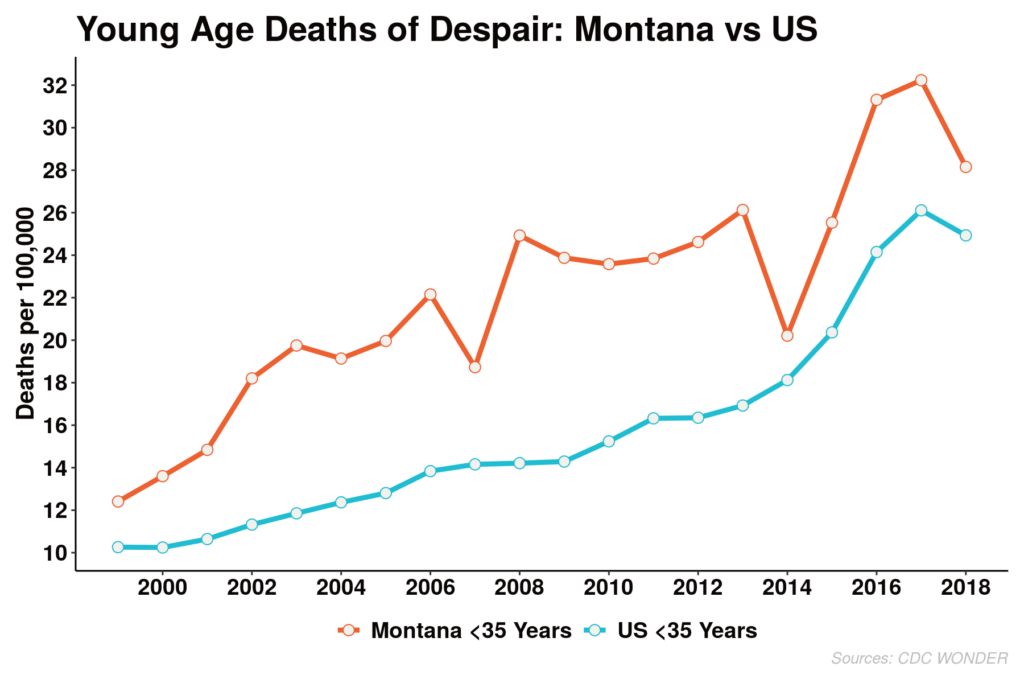
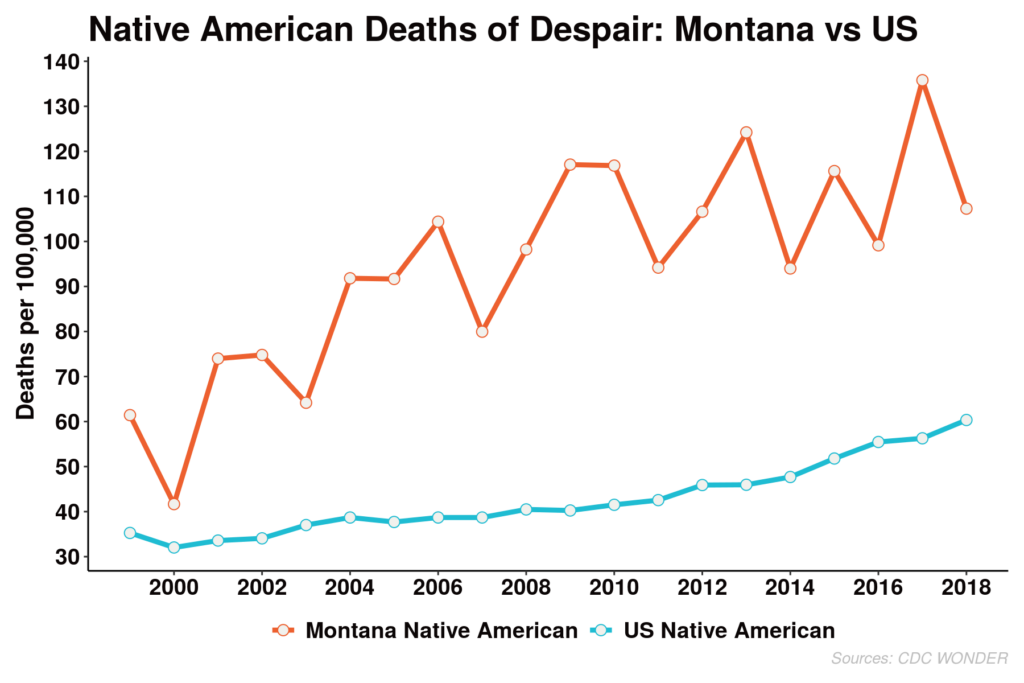
And so, as the United States saw a strong and steady upward trend in deaths linked to suicide, alcohol and drugs, Montana moved up in tandem with other states. History and geography, however, give the problems that lead to early death a particular, and particularly challenging, profile. Montana is seeing rising numbers of deaths among young people, and it’s seeing that trend among enrolled residents of the native tribes that call Montana home.

The Montana Landscape

This piece is the second in a continuing series of reports on Deaths of Despair across the nation by the American Communities Project funded by the Arthur Blank Family Foundation. Our first report, in July, laid out the size and impact of the problem across our 15 county types. Data analysis and visualization are provided by the Center on Rural Innovation.

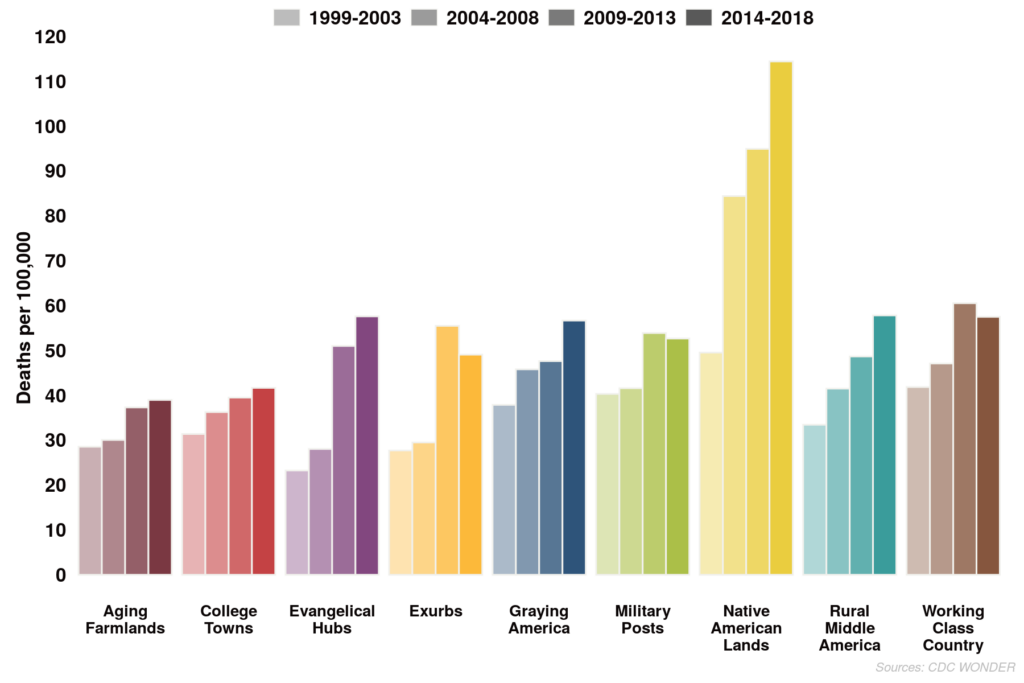
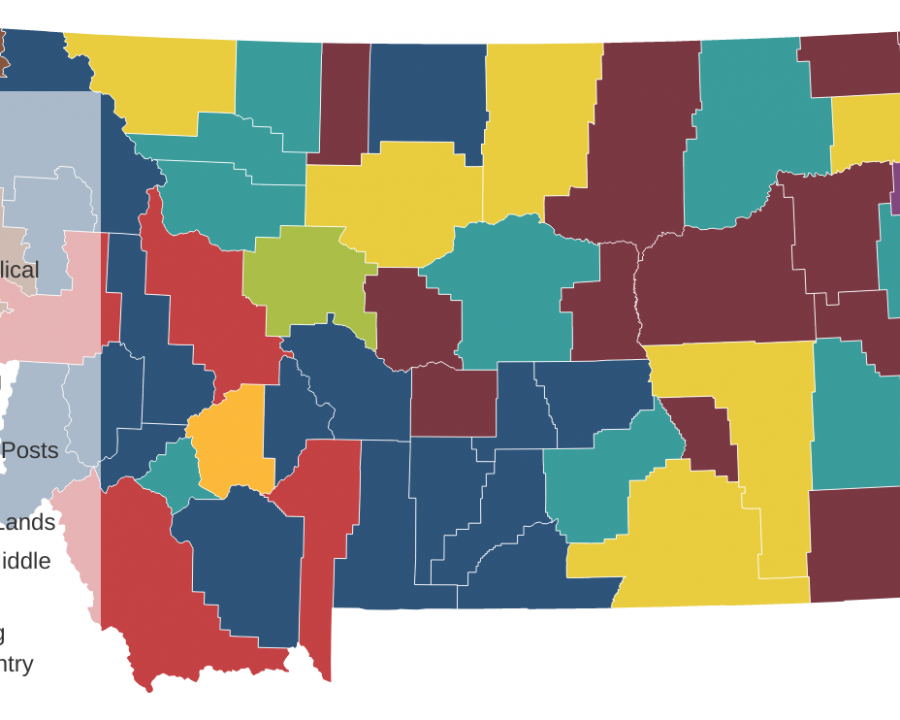
The state is not very diverse. The Census Bureau puts the white population at about 86% and the Native American population at roughly 7%, meaning Asian and Pacific Islander, Black, Latino, and mixed-race populations only make up about 4% of the state’s people. The trip from the western border with Idaho to the eastern border with North and South Dakota, at about 750 miles, is longer than the trip from Washington, D.C., to Chicago, which would take you through five or six states. And even if Montana is not known for racial diversity, it holds a wide range of different community types. Within those far-reaching borders are counties classified using the American Communities Project matrix as Aging Farmlands, Working Class Country, Rural Middle America, College Towns, Evangelical Hubs, Exurbs, and Military Posts. With just a few exceptions, these various community types have seen significant run-ups in the numbers of deaths from alcohol and drug abuse and suicide.

Clustered on the eastern end of the state, the Aging Farmlands have seen a gradual rise in the deaths of despair. And on the western border, the counties that make up Montana’s Working Class Country have seen significant rises in all classes of early deaths.

Deaths of Despair by Year Groups [Colored by ACP Types]

A Long List of Challenges

I meet the state’s suicide prevention coordinator, Karl Rosston, as he is about to begin a training program for nurses on warning signs for people contemplating ending their own lives. “We’ve been in the top five for the last 40 years. As a matter of fact, we’ve been near the top since we started keeping data in 1918.”

At a cafeteria table at Montana State University in Bozeman, he describes a daunting set of variables, some of which have a solution, many of which don’t. “We’re a northern state. We have vitamin D deficiencies because we have less sunshine. And Vitamin D deficiencies are correlated with higher risk for depression.”

The opioid overdose problem that has been ending tens of thousands of lives in America for years is present in Montana, but not a leading factor in early death. Rosston noted that in 42% of his state’s suicides, alcohol was found in the body, the rates for opioids and other drugs are much lower. “I see a lot of people who use alcohol to self-medicate their depression or anxiety. There’s one problem with that, alcohol is a depressant. Using a depressant to medicate your depression is not going to work too well.

“We’re near the top in the nation in alcohol consumption per capita, in alcohol-related deaths and DUI. And then you throw in access to lethal means,” which, in Montana means firearms that are  easy to acquire in the state, “and you have a really major issue. Because bottom line: Nationally between 70 and 90% of suicide attempts are by overdose, but it’s one of the least lethal means, anywhere between 3 and 11%. But when you use a firearm it’s more like 90%. Nationally about 51% of all suicides are by firearm, in Montana it’s about 63%.”

Isolation is a problem. Simply put, at 147,000 square miles, but just a little more than 1 million people, much of the state is empty, or close to it, at a population density of just 6.7 people per square mile. It has about the same population as Rhode Island in an area about 95 times the size. Isolation is bad for depression, and vast distances make for practical challenges, said Rosston. “At the law enforcement academy, they tell me it can take an hour and a half to two hours to respond to a 911 call.”

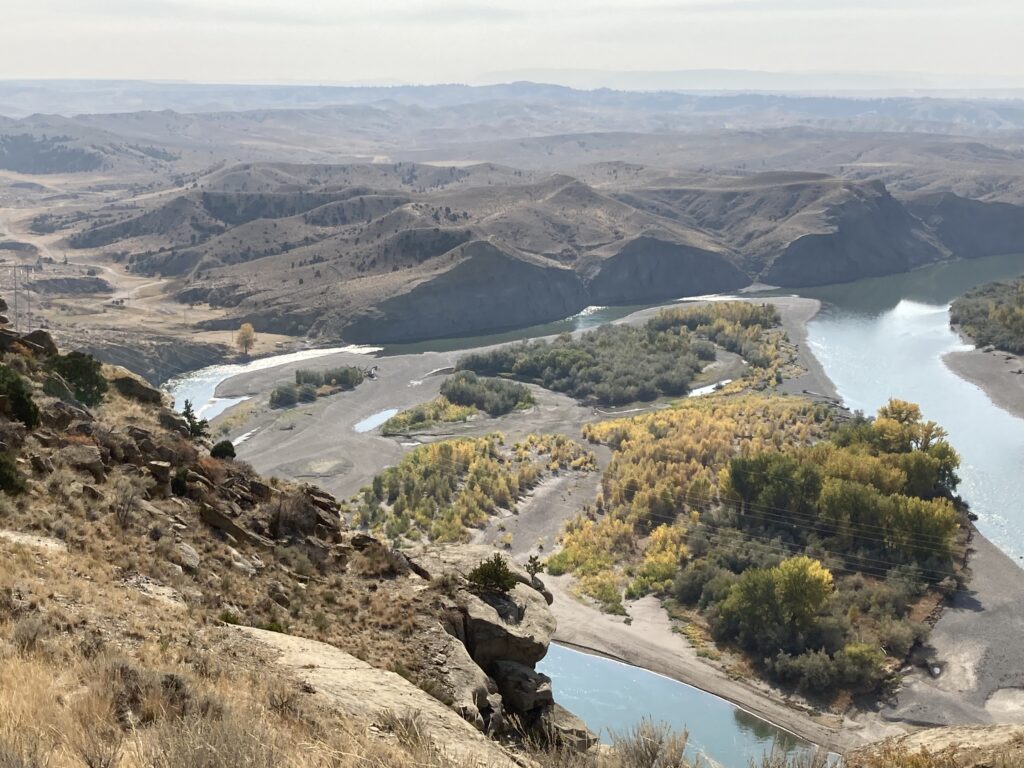
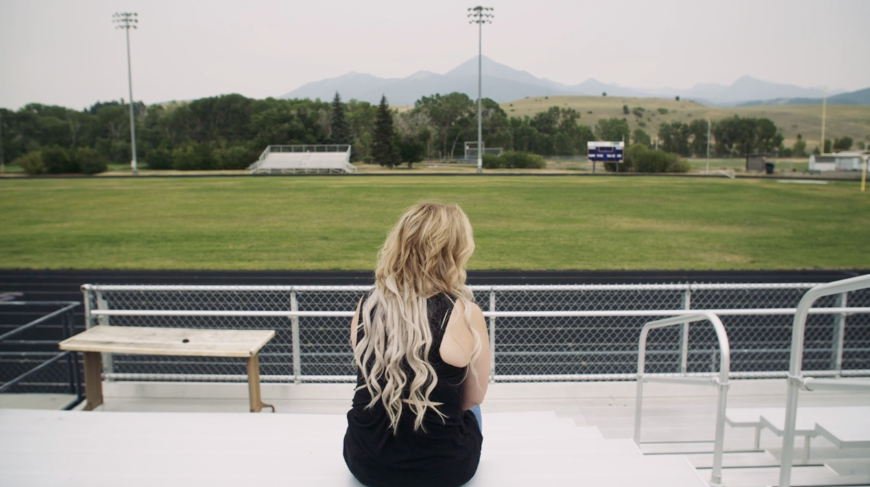
Yellowstone County, just outside of Billings. Montana’s population density is under seven people per square mile. Photo by Ray Suarez

When I asked Rosston, who reviews the death certificate of every suicide in the state, to give me a recent, typical case, he said, “You have a 40-year-old male, who has had a recent divorce. May have quit his job or is not working, chronic pain. Uses a firearm. Recent history of increased drinking. That’s the profile I see all the time. The relationship component is huge, as is the firearm.”

However, the disturbing growth Rosston sees in the numbers are not among the middle-aged white men, the military veterans or the chronic pain sufferers who have long buttressed Montana’s deaths of despair figures. Rather, he sees worrying signs among young people, and especially Native Americans, both in urban areas and on tribal lands.

Every state in the union contributes data to the national Youth Risk Behavior Survey. Montana’s 2019 numbers are sobering reading for anyone trying to understand the rise in deaths of despair. More than a third of the state’s teens say they felt so sad or hopeless for two weeks or more in a row during the previous year they stopped going to school. More than a quarter thought about suicide, and for about one out of five, it was serious enough to contemplate a plan for ending their lives. One in 10 had actually attempted to end their life. In contemplating, planning and attempting suicide, the rates for girls exceeded that for boys. Almost a quarter of high school girls, 23.5%, reported making a plan to end their lives, a rate roughly twice as high as that for high school boys at 12%. Some 12% of girls reported they had attempted suicide, a rate about 50% higher than that reported by high school boys. For boys and girls, the rates of all these suicide-related behaviors exceeded the national average. Among their Native American peers, the attempted suicide rate was almost twice as high.

The numbers are no surprise to Christina Powell, co-director of Bozeman Help Center, a crisis hotline. “If there’s a common thread, it’s the ability to tolerate loss. And when I say loss, I’m talking about everything. From things like, you know, a girlfriend or a boyfriend. Loss can be everything: loss of job, loss of status, relationships, loss of family. Loss is in some ways perceptual, in many ways concrete. All human beings experience a level of loss throughout a lifetime. That’s to be expected. Loss seems to be consistently there in moments of despair.”

THE CRISES FACING NATIVE AMERICAN YOUTH

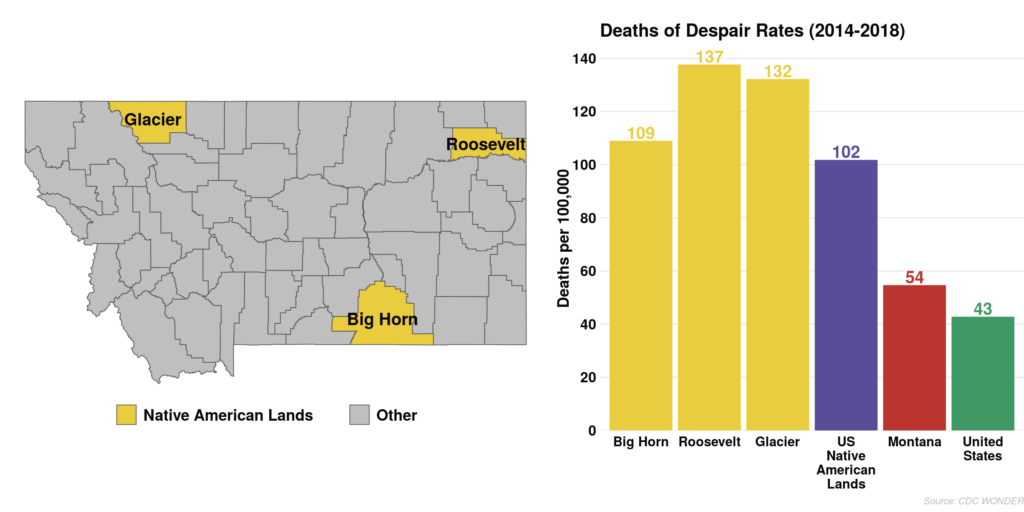
The Deaths of Despair numbers are particularly concerning in the Native American Lands county type in the ACP. Our first report noted how the rate in the Native American Lands of 101.6 per 100,000 people, was nearly three times the national rate of 38.3. And several Native American Lands counties in Montana (Big Horn, Roosevelt and Glacier) sit above the national figure for Native American counties. The roots of those high numbers are deeply tied to larger historical and cultural challenges in the Native American Lands counties.

Educator, activist and Crow tribal member Shane Doyle sees despair on the reservations, and says it makes sense, given what teenagers are up against. The Crow Reservation is mostly in Big Horn County. “Look at what has occurred here over the last 150 years. If you’re a kid, you think it’s normal to live in utter poverty. You think it’s normal to face a cascade of health issues. Unless you can see your way through to the issues of how we got here, you’re going to be weighed down by fatalism.

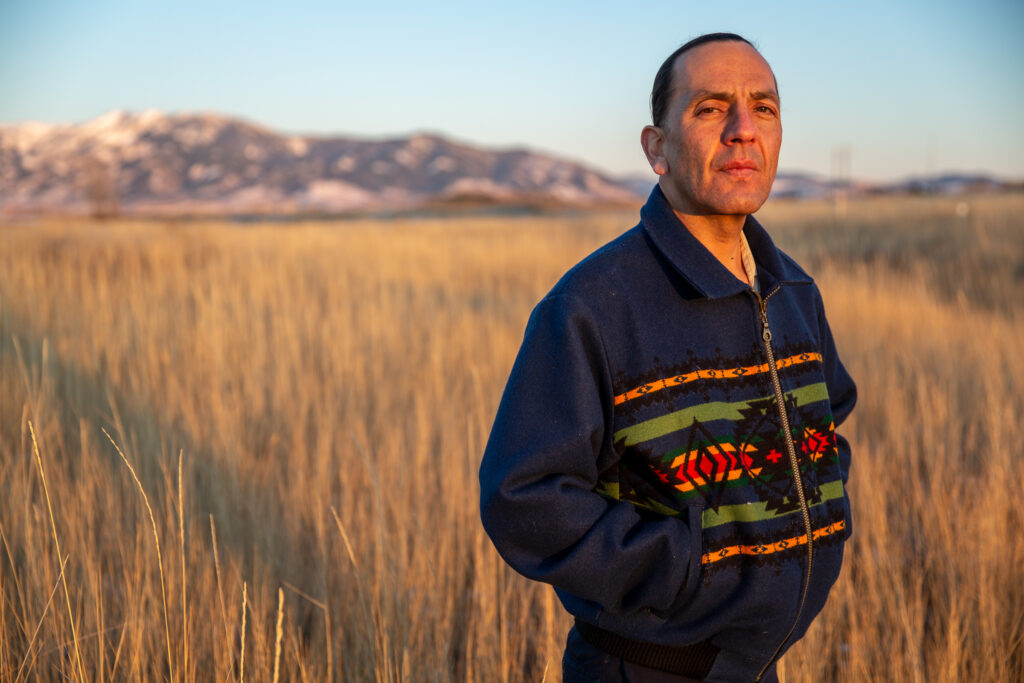
Shane Doyle near his home in Bozeman, Montana. Bridger Mountains in the background. Photo: ©Louise Johns 2020

“If you can’t describe how Native people were once proud and strong and healthy and resilient, if you can’t conjure that up in your mind, it’s going to lead you to believe either Native people deserve this, or are stupid, or lazy. Or you believe the myths, we can’t handle alcohol, or how you don’t fit into society. Myths made popular by books and media and movies.

“If you decide you don’t want to accept it, what options do you have?”

Speaking to tribal members and other Montanans, on the reservations and off, a phrase kept popping up in interviews: “historical trauma.” It can’t be measured by researchers, it can’t be tracked from year to year, or compared in state-by-state tables. For adults trying to head off the suffering and early death so common in Indian families, that trauma is as real and tangible as statistics about high school completion or drug possession.

“Think about what it’s meant to experience generations of catastrophic and cataclysmic loss,” Doyle said. “The whole process started with smallpox, diphtheria, typhoid, diseases brought here from outside. That was just the beginning of hard times for Native people here. Most of them lost at least 75% of their communities, then land stripped away.”

Along with poverty and physical suffering came cultural eradication, with children moved off tribal lands and away from families to boarding schools, not once, but for generations of children, an intentional stripping away of ancient languages and cultural knowledge. Doyle said, “It’s a community that’s been traumatized for well over 150 years, and hasn’t been able to regain its independence.”

The land is stunning. Jagged mountains emerge from golden grasslands. Threads of cloud crisscross the renowned sky. Suddenly curious cows raise their heads in unison to watch a single car come by on a gravel road. All that breathtaking beauty can’t hide the worn mobile homes, the sparse store shelves, the cracked windows mended with masking tape to hold the powerful wind rippling the roadside brush.

Confronting the Problems

Alma Knows His Gun McCormick is the executive director of Messengers for Health, a program on the Crow Reservation bringing education, advocacy and health services to tribal members. While identifying the need for better healthcare on the reservation as an important issue in fighting deaths of despair, McCormick does assign a role to historical trauma, as well. The role of rejection in the history of her Crow people and other Montana tribes is underestimated, and it binds her people to this day. “We see the natural events, boarding school, broken treaties, racism,” she said. We can describe those facts, but underlying all of it, it’s a spiritual thing … it’s rejection. Because of being displaced, having our lands taken away, assimilating to a culture different from ours, we experience a spiritual rejection.”

McCormick connects her people to essential health services and the latest diagnostic procedures, and at the same time assesses something harder to see, “a heaviness” that keeps her people in its strong grip. “That identity, those values, that’s what has kept us over the years, facing adversities of historical trauma. That is how we have overcome.”

Alma Knows His Gun McCormick, the Director of Messengers for Health on the Crow Reservation, Montana. Photo: ©Louise Johns 2020

McCormick said the Indian Health Service, an arm of the federal government, makes mental health treatment available for tribal members, but stigma makes even those in deep trouble shy away. “They don’t seek it out. Confidentiality is key and, unfortunately, that’s one of the barriers that keeps people from going to Indian Health Services, lack of confidentiality. And not only in the area of mental health, just going and receiving healthcare.”

In small communities like Crow Agency, it is well-understood that people have mental health and drug counseling needs, McCormick said, but there is little confidence that a family’s private matters would stay private. “Information seems to leak out. Everyone knows everyone. If they went to an appointment, maybe they were diagnosed with something, or if some things going on, information goes out.”

If they try to go elsewhere, it can mean a long drive. “People have to go into Billings if they want to see a specialist. It’s a hundred miles round trip, and transportation can be a significant barrier to people seeking healthcare.” During the COVID emergency, burning through Montana through the autumn and into the winter, McCormick was able to use pandemic relief funds from the state to issue $30 gas cards, which allows a reservation family to make the long trip to the state’s biggest city. Some communities on reservation land are much farther away, and get a $40 card to cover the gas.

As a licensed clinical social worker, and a man immersed in data from his state and around the country, Karl Rosston easily rattles off the numbers that define his state’s challenges from untreated pain to distance to the nearest psychiatrist.

He also cites both historical trauma and an alienation from the tribal past as big factors in suicide rates on the reservations, about twice the national average. “Where we often see a huge gap is between the youth of the tribes and the elders. The elders, one of their main jobs, is to pass down the traditions of the tribe. We see a huge gap where these kids are not learning their culture, not learning their language, not learning their healing ceremonies, and you have a generation of lost kids. Then they’re exposed to poverty and addiction and crime and gambling and everything else evident on our reservations, and you can understand why you have such a high rate of despair, and suicide.”

Underlying Issues

The pain of too-early death is present across the Native American Lands counties of Montana. There is a strong desire for change, and there’s an acknowledgement that high levels of family dissolution, substance abuse and joblessness cannot be changed overnight. Lack of daylight and altitude that reduces the effectiveness of anti-depressants are impossible to change. Tribal members wrestle with the long- and short-term nature of their challenges and try to find near-term solutions that save lives, while still wishing to tackle the big, structural problems.

Peggy White Well Known Buffalo said she saw problems everywhere she looked on Crow lands: drug abuse, alcoholism, domestic violence and threats to the maintenance of the language and the tribe’s traditions. With her Center Pole project, she tried to pick off those problems one by one, providing a cultural hub, a source of nourishing food, and training in Crow arts and traditions. We talked in the Center Pole’s café as she gave instructions and greetings in Crow to workers and volunteers bustling in and out.

White said a vision during a traditional sun dance pointed the way. In her vision, she walked past tables full of food and saw an Indian man who told her to “feed the ones that need it. Give it to people who don’t have.” Switching back and forth between English and Crow in the story, she recalled, “I know what it is not to have food. I can remember not having enough to eat.”

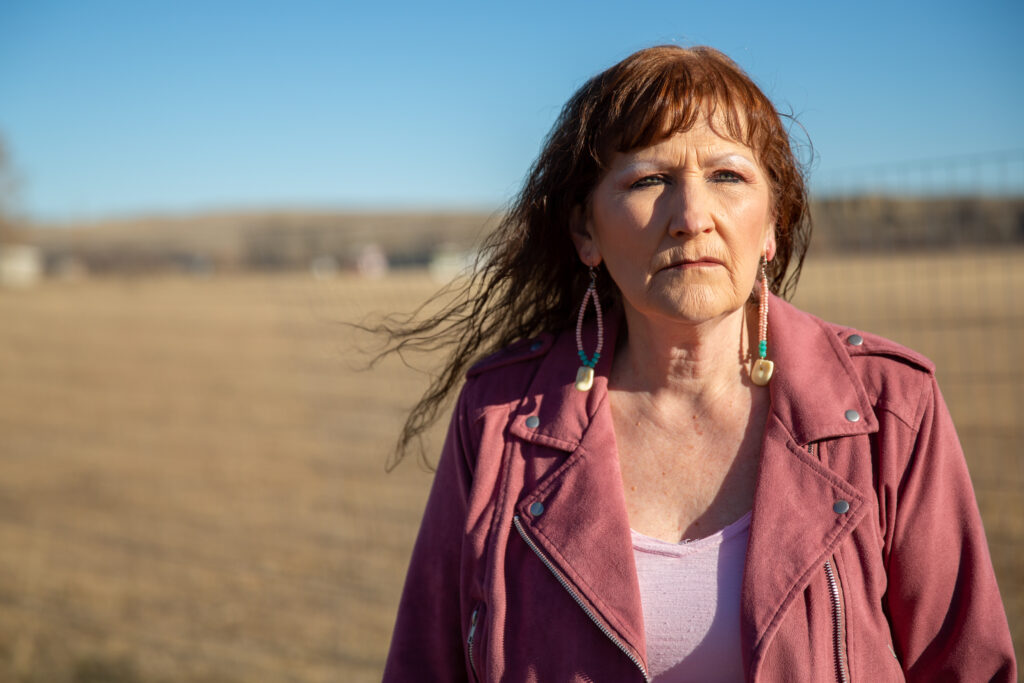
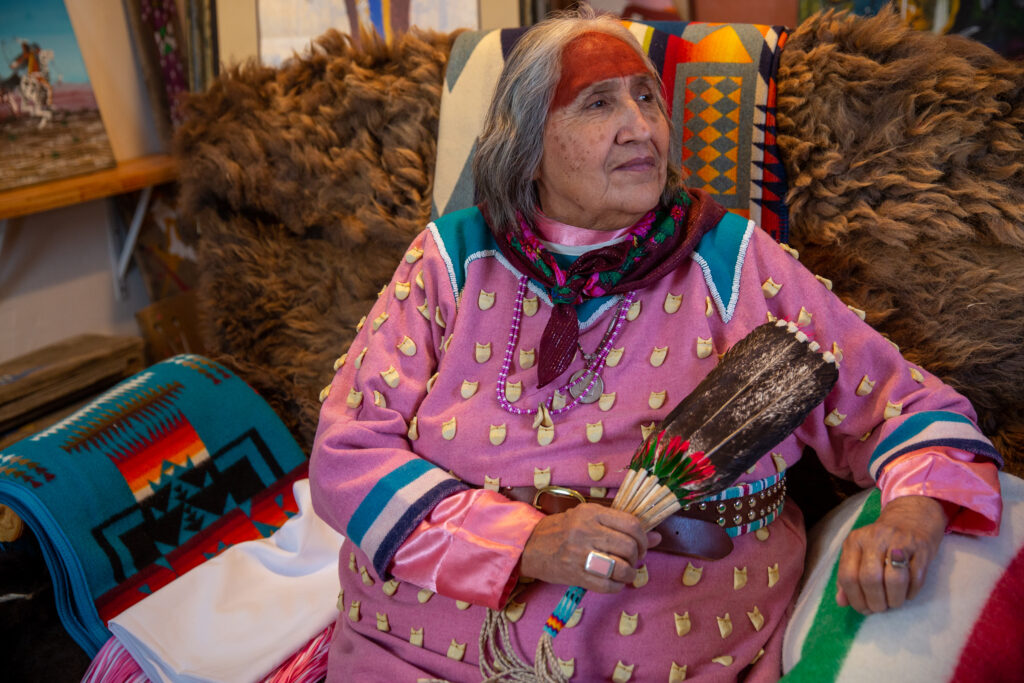
Peggy Well Known Buffalo sits inside her coffee shop and gift shop at The Center Pole on the Crow Reservation, Montana. Photo: ©Louise Johns 2020

Reluctant to use the term “mental illness,” White recalled her own grandson’s death, just weeks before. In a video addressing White, her grandson apologized for ending his life and forced her to look back in regret, and wonder why she had not done more to pull the young man into her orbit. “Why didn’t I check on him when I didn’t see him for six months. Why didn’t I try to guide him in my spiritual beliefs? Why didn’t I try to spend more time with him? It was really hard.”

White works with recovering alcoholics and drug users, as well as children and adults who have suffered domestic abuse. Lightening the burden of historical trauma, White said, requires an approach to Native people that preserves the best of their past to bring healing and balance to the present. She takes young people to Crow holy places, teaches them the use of native plants for religious customs and herbal remedies for medicine.

Young Tribal Members

McCormick is committed to getting her people treatment, and she wants to find an approach that incorporates a heavy influence of Crow traditional teaching into a community health model to combat substance abuse and early death. “We are designing it right now. We’re researching intervention on how to improve self-care when people have chronic illness. It shows very strongly our people need mental and emotional wellness support. We set up a support group with our cultural ways, our language, our kinship, our wisdom passed down.”

Collena Brown grew up in the tiny town of Grass Lodge and has lived there almost her entire life. She watched as the local Boys and Girls Club, run by the tribe, lost its charter and went belly-up. Though her family was preparing to leave town for new work, Brown instead revived the charter, and is running her new club separately from the tribal administration. “We started everything from the ground up, from finding board members, finding funding. I had never written grant applications in my entire life.”

The new Boys and Girls club was finding its feet just as the Crow reservation grappled with the coronavirus pandemic, and school-age children were sent home to learn remotely, with very little support or follow-up for remote, self-guided learning. Toward the end of the year the schools remained closed. Brown is trying to keep kids current with their studies while supporting parents who must work. “The kids know that we’re there, that we’re here to help them.” The Boys and Girls Club is hiring high schoolers as tutors, and raising up leaders at the same time. “We’re teaching them the joys of having a job. The responsibility of looking after themselves. We don’t take calls from parents. If you can’t make your scheduled shift, you have to call.

“We’re making sure the teenagers know what responsibilities they have.”

She worries about the threat of early death, the kids she can’t reach in time, and what to do about their memories. “We almost glorify the ones who had committed suicide. We have to remember them, but I don’t think we should make it bigger than it is, so that the youth see it in a good light.”

Brown said she sees teenagers who are nearly on their own, with loose association to broken families, and homes far removed from other connections. “They have no relationship with their parents. No support whatsoever. A kid is looking for a safe place, somebody who will listen to them. In town, it’s a little different, maybe you have to be a little careful where you go. But farther out? A lot of them are stuck out there.”

Overcoming Isolation and Finding Meaning

That isolation, that lack of connection, is dangerous for people in crisis whether they find themselves miles from the nearest town on the Crow lands, on a farm first planted by European ancestors at the turn of the last century, or in one of Montana’s small cities. Kathy Allen trains the crisis counselors who work the phones at the Bozeman Health Center, and said the combination of shame and isolation leads people to crises they conclude they cannot share with the people around them. So they end up on the phone. “Part of our job is to reduce that shame, validate that the person is in pain, that of course these thoughts are coming up for them.

“I talk to a lot of teenagers who feel shame about reaching out. In Montana, there’s a mentality around not needing help, being able to get through things on your own.”

Resilience, and the lack of it, was identified as a culprit on reservations and off, among people of all races and ages. “It’s not just money,” said Shane Doyle. “You can’t just give a kid money and say, ‘Now go and be happy.’ There are a lot of angry young men here in Montana. And they’re angry because they haven’t been able to connect and express their humanity.”

Karl Rosston wants to screen for depression among every child in the state by the age of 15, a common age of onset, to get help early to someone who might otherwise endure decades of suffering that ends in early death. He is training nurses around the state to look for the behavioral clues to someone more likely to die a death of despair. “The more tools they have, the better they’re going to be able to recognize and identify these people that are at risk.”

Christina Powell wonders about what has changed in society. She knows there are a lot of walking wounded among us, and at the same time wonders if it is the challenge of daily life that has changed, or us? “What is our ability to tolerate loss? Is it being degraded as time goes by? Is there an increase in the experience of loss? That’s hard for me to believe.

“Are we adequately preparing our children to face loss?”

Shane Doyle said we never ask the most obvious question: “What does it mean to have a high quality of life? Our education system has been built to produce workers.

“How about happy human beings?”


Ray Suarez is co-host of the public radio program and podcast World Affairs, and covers Washington for Euronews. He is the author of three books on American life, most recently Latino Americans: The 500-Year Legacy That Shaped a Nation.

Food

Gauging and Tackling Food Insecurity During Covid-19

by Ari Pinkus November 23, 2020

Covid-19 is widely thought to have triggered the worst economic crisis since the Great Depression, surpassing the Great Recession that caused significant hardship just over 10 years ago — the problem of hunger vividly displayed by food lines across America these past eight months.

Earlier this month, Feeding America released a forecast of the total population in food-insecure households based on projected changes to annual unemployment and poverty resulting from the pandemic. In Feeding America’s definition, this “assumes a national annual unemployment rate of 11.5% (7.6 percentage points higher than 2018) and a national annual poverty rate of 16.6% (4.8 percentage points higher than 2018).”

The American Communities Project examined these numbers county by county and distilled the percentages into the 15 community types in the graphics below. Hit the hardest in percentage are communities of color — Native American Lands, the African American South, and Hispanic Centers — as well as the mostly white Evangelical Hubs and Working Class Country.

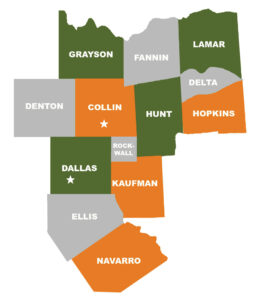
The 13 counties the North Texas Food Bank serves.

“Every food bank, whether they serve urban, suburban, or rural hunger, was impacted by Covid-19 with its widespread health and economic impact. You cannot prepare for that, but food banks have responded. This is what we do — we stand in the gap for those who need our help,” says Trisha Cunningham, president and CEO of the North Texas Food Bank, which serves 13 counties: the Big City of Dallas; Navarro in the African American South; the Exurbs of Denton, Collin, Rockwall, Kaufman, and Ellis; and the Evangelical Hubs of Fannin, Hunt, Grayson, Lamar, Delta, and Hopkins.

Covering 10,000 square miles in area, the North Texas Food Bank ended its fiscal year in June providing nearly 97 million meals — 5 million more than its 2025 goal, and 12 million more than anticipated before Covid. Today, NTFB is providing access to 10-11 million meals per month versus a prior year rate of 7-8 million.

In a wide-ranging interview, the ACP asked Cunningham about the scope of the problem in her area, how she and her team have been managing, who’s helping, what’s working, and what worries them this winter. Our edited exchange is below.

Ari Pinkus: Could you describe what you’re seeing in your community and hearing from customers you serve now? How does this compare with communities near you?

Trisha Cunningham: We hear from our network of 200+ partner agencies that clients they serve are understandably worried and stressed. Many have lost jobs or have seen reduced hours.  And there is so much uncertainty around not just the virus itself, but around employment, government assistance programs and schools, on which many children and families rely on for meals.

But our clients are also extremely grateful, resilient, and strong. They often must make difficult choices, such as buying groceries one week or paying a utility bill or filling a prescription, and many were facing these challenges even before the pandemic.

According to Covid-related projections from Feeding America, NTFB’s service area has the second highest number of food insecure people in Texas (behind Houston).

Pinkus: How have the demographics of people you serve changed in the pandemic? Could you talk about the increased need? 

Cunningham: Pre-pandemic data reflected the lowest food insecurity rates seen since before the Great Recession. However, the coronavirus pandemic is going to change these numbers in all 50 states, including Texas. Feeding America projects one in five North Texans may struggle with hunger this year, including one in four children. This encompasses almost 900,000 individuals.

Texas is projected to have one of the highest rates of food-insecure children in the country by the end of 2020 — a staggering number of 2.1 million children. This is a 28.7% food insecurity rate, up from 21.6% in 2018.

At the North Texas Food Bank, we have always served the working poor, children and families, and vulnerable populations such as seniors, veterans, disabled individuals, and the homeless. The pandemic has exacerbated the challenges that many people were already facing. At the same time, we have also seen that approximately 40% of individuals nationally are new to charitable food assistance, including many in North Texas.

Overall, we are distributing about double of what we did pre-pandemic. This demonstrates both the depths of the hunger needs that had already existed in our area and the impact that the Covid-19 pandemic has had on food insecurity and hunger.

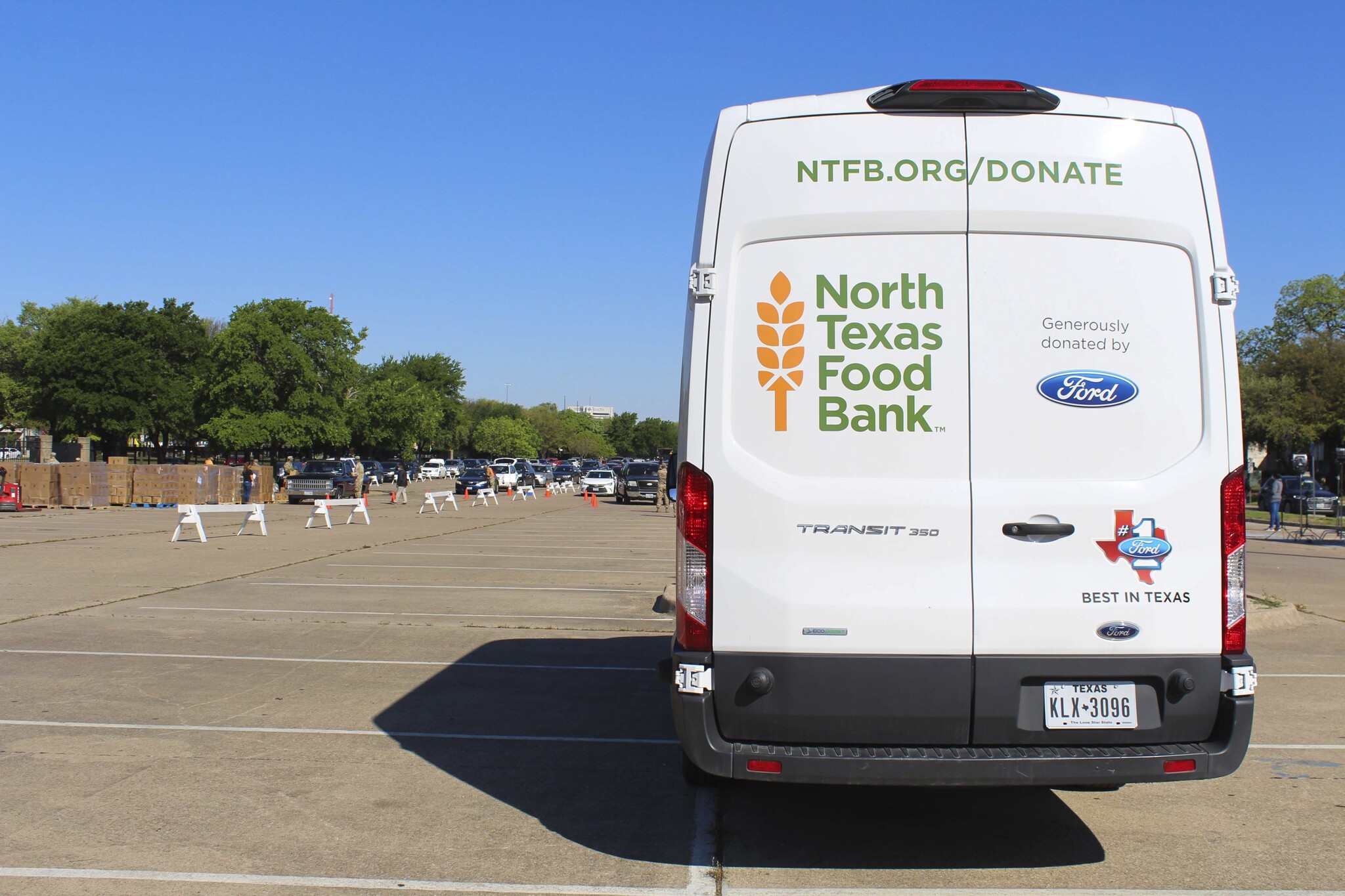
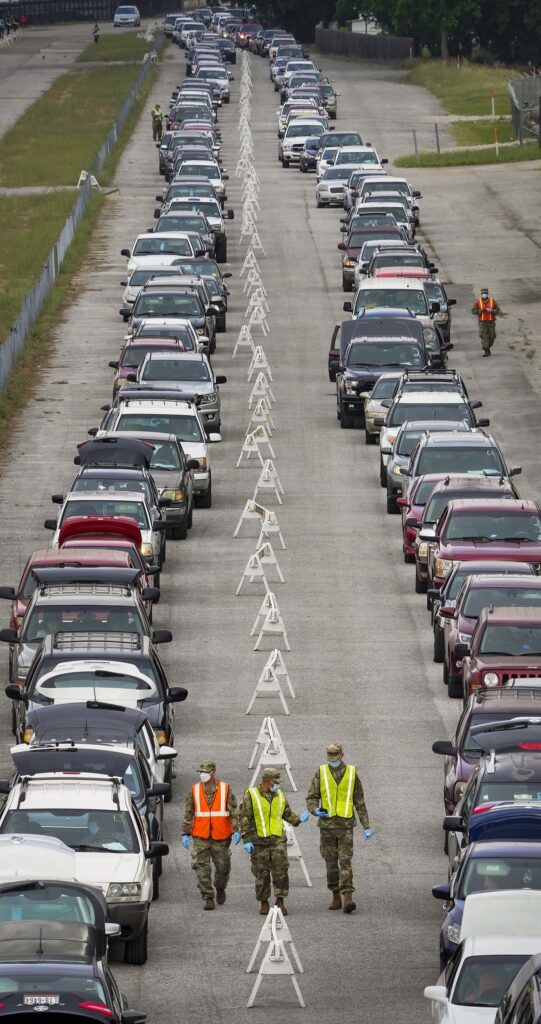
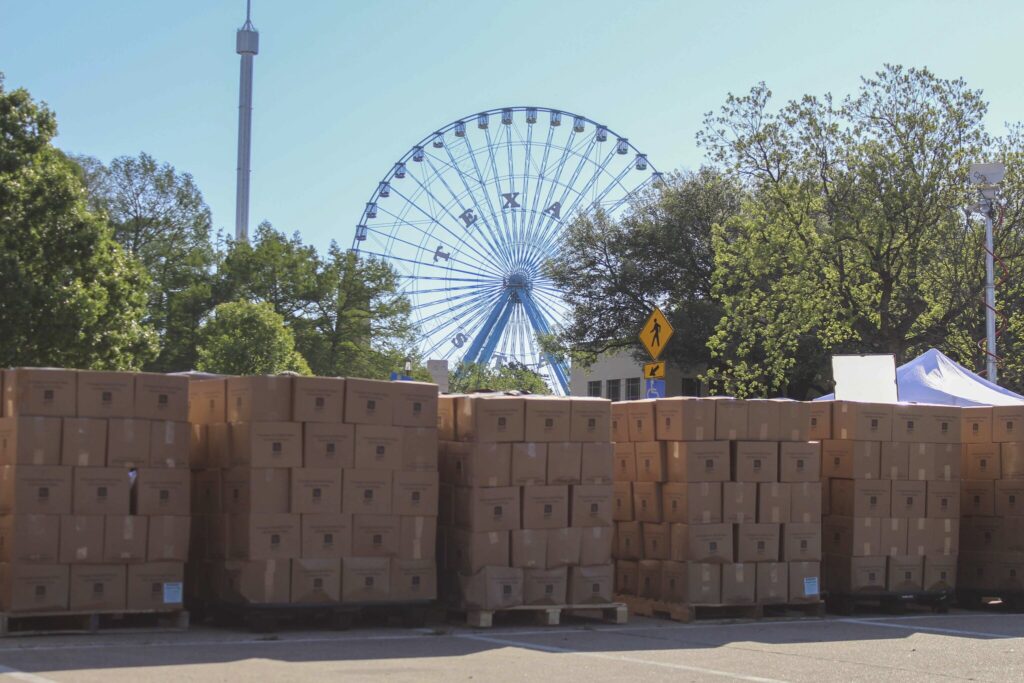
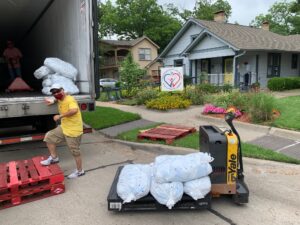
A line of cars at Fair Park, South Dallas in spring 2020. Photos courtesy of North Texas Food Bank.

Pinkus: How have you changed your staffing and practices to meet this new demand, and what Covid-19 precautions are you taking?

Cunningham: At the onset of the pandemic, we flipped our business model to provide nutritious kitted boxes of food that could be delivered in a low- to no-touch method.

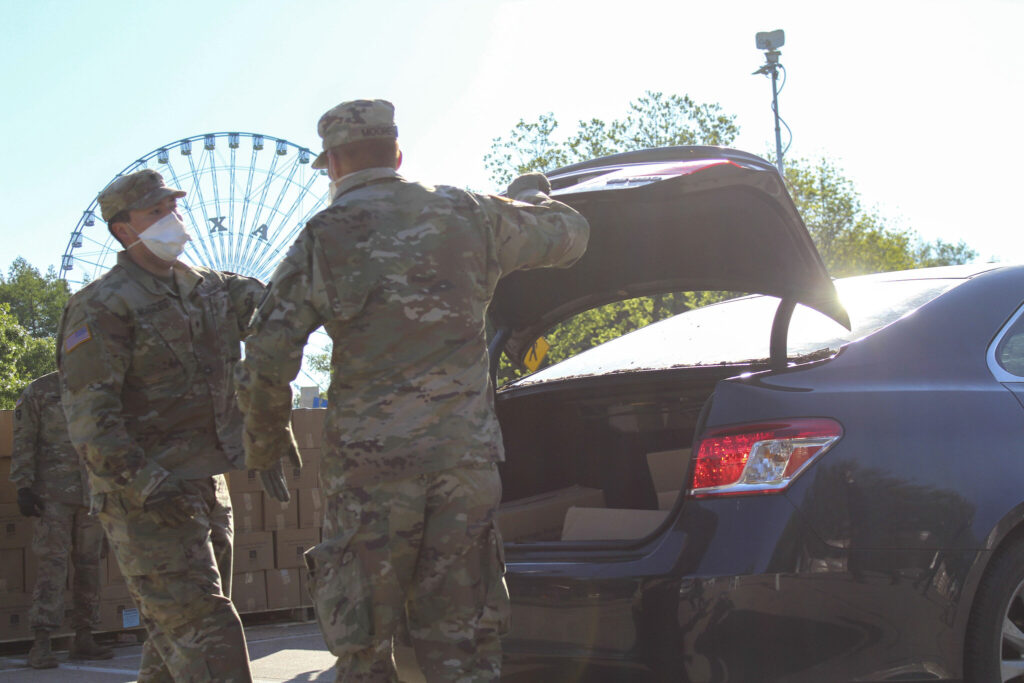
This required more labor to kit the boxes at a time when we had to halt our traditional volunteer operations. Many staff members hit the production floor to sort and pack boxes and to distribute foods at our mobile distributions. As our community’s needs increased, we tried to exhaust all resources and applied for Texas National Guard support. A small group is with us through December 2020.

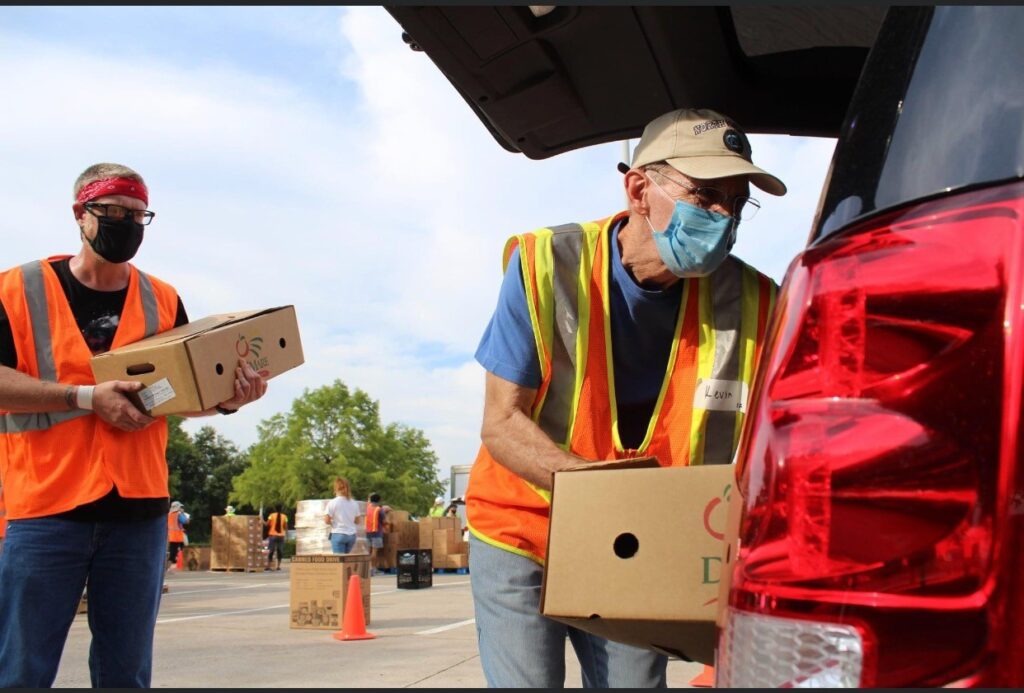
Times of crisis also spawn innovation. A partnership spearheaded by our board chair brought together funders through the Communities Foundation of Texas and technology through the company Shiftsmart, which is helping displaced hospitality workers be paid to fill the vacated volunteer roles at local nonprofits. The North Texas Food Bank was the initial pilot and the model has expanded nationwide. It is a win-win that we will continue to use as long as there is community support. We are excited to have opened back up limited volunteer opportunities for external groups that operate under strict health and safety precautions.

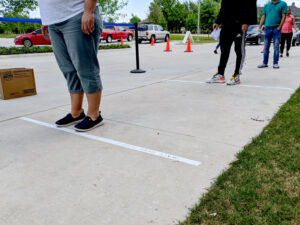
We ramped up our own direct service through mobile distributions in areas of highest needs across the 13 counties we serve. These distributions are done drive-thru style to implement social distancing practices, and we have received tremendous feedback from the community, with our efforts in Fair Park in South Dallas serving as the largest scale mobile pantries to date (see pictures).


Pinkus: What federal, state, and local support has your organization received? Are you receiving support from unexpected places?

Cunningham: We have received overwhelming support from our elected officials. Since day one, we have ensured they were involved in understanding how we are working in their areas and where they can use their connections to help get their communities increased access to food.

Direct support has come through a few channels. We accessed emergency funds due to the emergency disaster declarations at the local, state, and federal levels. State of Texas Assistance Requests allowed the emergency feeding network to access funds to purchase food and supplies directly from the food supply market. Additionally, this request allowed us to access workforce support by the National Guard after we lost most of our volunteers.

We also benefited from the CARES and Families First Coronavirus Response Act.

The USDA created a short-term program that created grocery food boxes to ease truck-to-trunk style distributions keeping everyone safe and to help get more food out into the community.

We are also grateful to our Texas State Agencies who have issued multiple waivers that have increased SNAP and Emergency Food access. These waivers have increased the flexibility of requirements, removed barriers, and simplified many processes.

Honestly, we could not have met the food needs without the support of these programs. One of our greatest concerns now is how we can support the long-term needs. We have not seen any drop in demand, but many of the government programs are slated to stop by the end of 2020.

Pinkus: What policies have been most helpful to you?

Cunningham:

  1. Simplifying the TEFAP intake form, the form required for households to receive emergency food from the USDA. This simplified form helped allow many of our partner agency-led and our own mobile distributions by reducing the 2-page intake form down to four simple questions, and not requiring a signature, thereby keeping everyone safe from direct interactions.
  2. SNAP flexibility – Virtual online application assistance and waiving work requirements allowed so many who either could not leave their house or had lost their jobs to access SNAP benefits and purchase meals for their own families.

Pinkus: What constitutes a meal, and how do you ensure healthy food options for customers?

Cunningham: We follow Feeding America’s guidelines that 1.2 pounds of food equals 1 meal. We have a dedicated nutrition team with whom we consulted when putting the kitted boxes together to ensure the contents were well-balanced and nutritious.

From the onset of the pandemic through October, 93% of the food distributed has been nutritious (NTFB utilizes the Dietary Guidelines for Americans as its primary guide in determining what is considered a nutritious item).

We have been focused on our produce distribution for years, and it is especially important now. The Food Bank works to source fresh produce from local and national growers and rescues unsold produce from grocery store retailers. Produce is distributed through a variety of sites and programs, including NTFB Partner Agencies, the School Pantry program, and our Mobile Pantry program. Distributing these delicate products requires refrigerated warehouse space, refrigerated trucks, and an investment in manual labor to get the products out quickly.

During Covid-19, our Nutrition Services team revamped its services to include a robust online and virtual presence, including cooking demonstration videos that coordinate with our kitted food boxes, online recipes, and targeted virtual workshops for children, seniors, and families.

Pinkus: What are your biggest worries heading into the holiday season and the winter?

Cunningham: We know that having access to a holiday meal is important to all families. Hunger is a year-round issue, and we are always working to address this. We are working with our partner agencies to ensure they have the food they need for the expected increased demand and to distribute food as safely and efficiently as possible, including our mobile pantry distributions which will continue through the holidays. As more people gather indoors with the winter weather, we could see an increase in Covid-19 cases, which leads to further economic and financial impact on already struggling neighbors.

The holidays are also normally our busiest time for fundraising. We are working to ensure a strong fundraising season so we can continue to support the increased need in our community.

Pinkus: How do Americans’ plans to stockpile food affect what you see at your food bank?

Cunningham: Early in the pandemic, we all heard stories of empty shelves in local stores. With higher demand, supply was very tight, and everyone was vying for the same resources — shelf stable and canned foods. This led to a strain in the supply chain and our partners could not donate as much as they normally do. It also led to higher prices and longer lead times. We have had to purchase more food items to maintain the inventory necessary to meet the increased demand.

Pinkus: To what degree are you receiving increased donations in money and/or food from Americans who see their neighbors and fellow citizens in greater need? 

Cunningham: North Texas has always been an extremely giving community, and this has been true as we work through the most substantial crisis we have ever faced. We used to say that hunger was a hidden issue, but I do not think it is hidden any longer. Because of that, thousands of our neighbors (and beyond) are donating for the first time. This is alongside our steadfast supporters who have trusted us and empowered us for years.

The estimated value of the NTFB Covid response through October was $47.2 million. This is costly but vital for our community. We know the impact of this crisis will continue at a high level long after the stories of families seeking food assistance have left the public eye. We are incredibly grateful for the outpouring of community support we have seen over the past few months.

Pinkus: How are you seeing this crisis as an opening to educate your community around food insecurity and dispel misconceptions?

Cunningham: The emergency food safety net has been around for quite some time, but it has always been a challenge to convince everyone that it is necessary and must be fully supported. What Covid-19 has allowed is for those of us in the anti-hunger space to demonstrate that the large federal and state programs that fight hunger not only work but should be able to be accessed by all.

Many families have found themselves in a new situation in which they did not plan to be, but long-standing anti-hunger programs are helping them get food on the table in a crisis, just like they are designed to do. Fighting hunger is a nonpartisan issue, and I think we can all agree no one deserves to be hungry.

Vol. 3 2020-2021

Deaths of Despair Across America

The American Communities Project is undertaking a 30-month study of Deaths of Despair in its 15 community types.

Learn More
Politics

As the Election Closes In, More Americans Seek to Mail In Ballots — But Concerns Abound

by Ari Pinkus July 29, 2020

Despite the consternation around mail-in voting during the pandemic, a clear majority of Americans are leaning toward voting by mail this fall — if they can. At the same time, a majority say they are concerned about the accuracy of counting votes submitted by mail. Minority centers, encompassing the African American South, Hispanic Centers, and Native American Lands, show the most concern about the accuracy of ballot counting, no matter the means of voting: mail, electronic, or paper.

To Vote or Not to Vote by Mail

A Dynata survey taken some 100 days before the presidential election finds that 60% of Americans are very or somewhat likely to vote by mail if it’s an option for the general election, while 28% say they are somewhat or very unlikely to use this method. At this point, 12% are not sure. California, Vermont, and the District of Columbia join Colorado, Hawaii, Oregon, Utah, and Washington in automatically sending all registered voters mail-in ballots.

The likelihood also ranges widely depending on a resident’s community type: In Big Cities, 68% say they are likely to vote by mail if given the choice, while in minority centers, 48% say so. (In minority communities, 30% say they are unlikely to vote by mail.)

Of all the community types, the less diverse Middle Suburbs are most split between whether or not they are likely to vote by mail: 49% say they are, while 39% say they are unlikely to mail in ballots. Compare those percentages to rural white communities, consisting of Aging Farmlands, Evangelical Hubs, Graying America, LDS Enclaves, Rural Middle America, and Working Class Country, where 50% say they are likely to vote by mail, and 34% say they are unlikely to vote this way.

These disparities may be explained by the circumstances in different kinds of communities.

  • Big Cities have suffered mightily these past four months from the coronavirus pandemic and have been contending with many protests. Residents may be more hesitant to venture out to the polls and potentially expose themselves to health and social concerns.
  • Minority centers have long been disenfranchised in the voting process, and concerns remain high about voter suppression in communities with large African American, Hispanic, and Native American populations. Many residents may not trust that their vote will count if they use an alternate method to in-person voting; they may also have unstable housing situations, making mailed ballots difficult to obtain and return.
  • The Middle Suburbs, made up of 77 counties concentrated the Northeast and upper Midwest, have been ravaged by deaths of despair, including drug overdoses, in the past several years. Longer-term, globalization and deindustrialization have taken a toll on these communities — and their residents. They went heavily for Donald Trump in 2016, but many are leaning away from him now. President Trump has denounced widespread mail-in voting, while he and his family vote by mail.

Concern About Counting

As election security steps into the spotlight again, there is a fair bit of concern about the accuracy of the vote count, regardless of the method used: 56% of Americans are concerned or very concerned about voting by mail, 50% say the same about electronic ballots, and 48% about paper ones, according to the Dynata survey. A majority in minority centers show concern with all three methods: mail, electronic, and paper.

Mail

Minority centers and Exurbs express the most concern about accuracy via mail-in voting at 63%. At the other end of the spectrum, Big Cities and Urban Suburbs are tied at 53%. Communities of rural whites, the young and mobile, and the Middle Suburbs are in the upper 50s.

Electronic

On electronic ballots, young and mobile communities — College Towns and Military Posts — show the least concern, while minority centers see the most: 41% of young and mobile communities say they are concerned or very concerned, perhaps because of their comfort with technology; 59% of minority centers express concern. Most communities hover around the average of 50% or tick to the low 50s.

Paper

While using paper ballots is slightly less concerning among Americans overall, 54% of minority centers say they are concerned or very concerned about the accuracy of paper votes counted, showing how voter disenfranchisement runs deep in the African American South, Hispanic Centers, and Native American Lands.

Vol. 3 2020-2021

Deaths of Despair Across America

The American Communities Project is undertaking a 30-month study of Deaths of Despair in its 15 community types.

Learn More

The American Communities Report

Deaths of Despair Across America

Read More
In This Issue

The American Communities Project is undertaking a 30-month study of deaths of despair across the country, supported by The Arthur M. Blank Family Foundation. These are deaths resulting from drugs, alcohol, and/or suicide. The study includes data analysis as well as on-the-ground reporting in Georgia and Montana. Participants are: Dante Chinni, director; Ari Pinkus, senior editor; Lee Banville, professor at the University of Montana; Andy Miller, CEO and editor of Georgia Health News; and Ray Suarez, on-the-ground reporter. Data analysis, mapping and graphics by the Center on Rural Innovation. Note: This page will be updated with new content throughout the span of the study.

American Communities Experience Deaths of Despair at Uneven Rates

by Dante Chinni July 23, 2020 Print

There’s a long list of measures that examine who is struggling in the United States — from poverty rates to income inequality — but in recent years a complicated set of personal struggles and challenges has come to be measured in one phrase, Deaths of Despair. This phrase describes deaths caused or brought on by alcohol and drugs as well as suicide. Behind the three words is a long list of root causes.

With this piece, the American Communities Project begins a two-year exploration into the causes and effects of Deaths of Despair, as well as positive interventions that might help decrease the phenomenon, funded by The Arthur M. Blank Family Foundation.

We’ll explore the term through the ACP’s 15 community types and analyze what drives the differences in deaths by community. The data raise many questions, including:

  • Why do some types of community seem to struggle with high numbers of Deaths of Despair and others do not?
  • How much of a factor is the racial composition or median age of a community, or the economic situation on the ground?
  • How do some communities overcome their challenges?

This effort will also explore the impact of the Covid-19 pandemic on Deaths of Despair in the United States. The Well Being Trust has already written that the pandemic could lead to an additional 75,000 deaths from alcohol, drugs, and suicide.

Three Major Findings

This first article on the topic is a snapshot of what has become an important issue in the American discourse on health, well-being, and socioeconomics. An analysis of Centers for Disease Control and Prevention data from 2014-2018 with the help of the Center on Rural Innovation reveals three major findings.

  1. On the whole, urban places are faring much better that rural ones in the Deaths of Despair data, but they are not immune. There are notable differences among different kinds of urban communities, particularly the blue-collar Middle Suburbs, where the numbers are high.
  2. Deaths of Despair rates do not break down cleanly along white and nonwhite community lines. In particular, communities of color have vastly different experiences with Deaths of Despair. Native American communities have suffered greatly, while communities with large African Americans populations have not.
  3. Traditional economic and educational measures of a “thriving” community are not wholly determinative. Some “struggling” communities have high Deaths of Despair numbers while others have lower ones. The finding suggests other cultural factors play a bigger role.

Diving into the data brings a fuller understanding of these points.

The ACP Frame and Findings

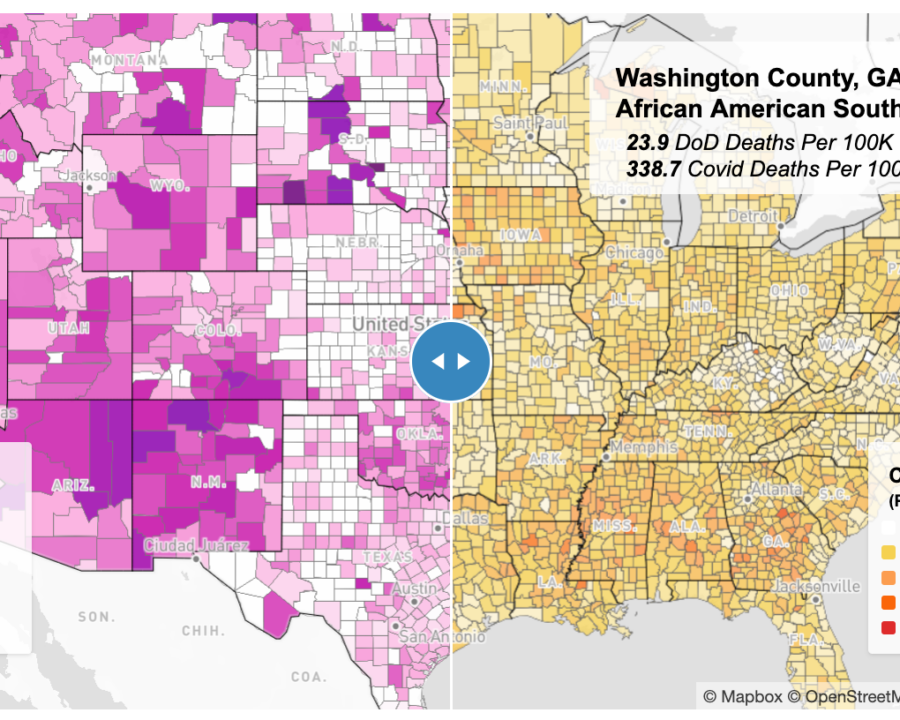
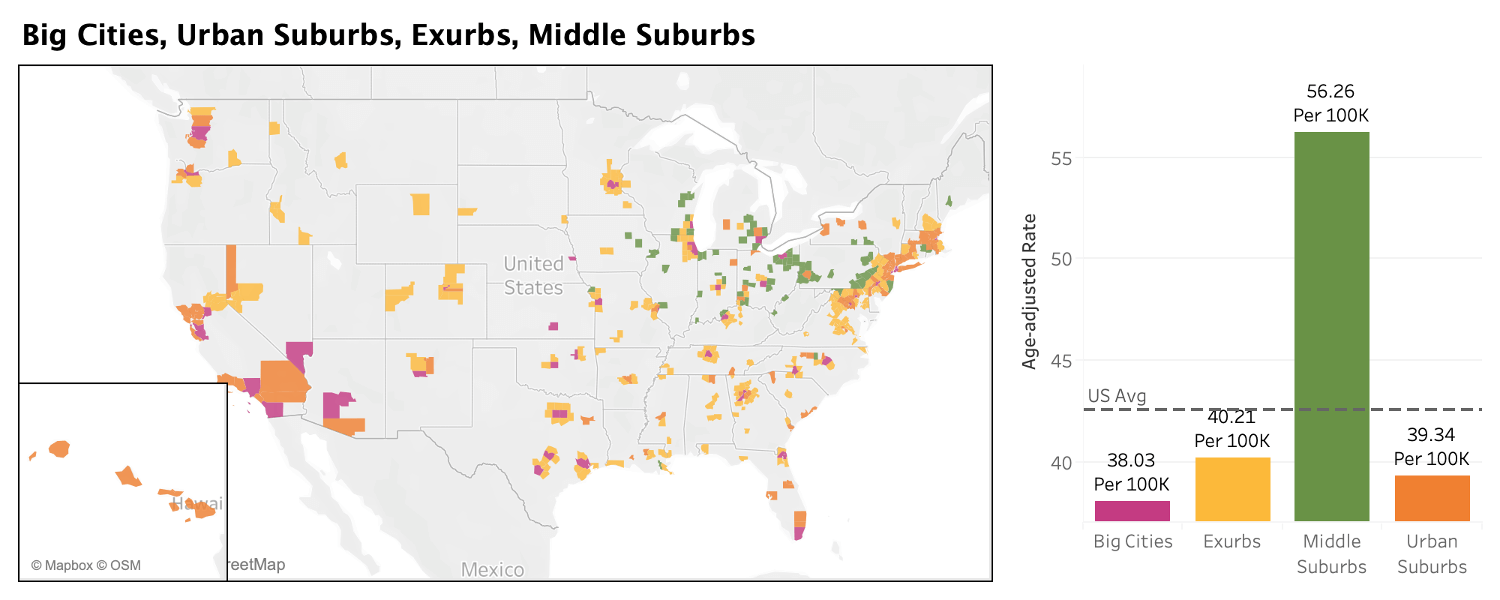
The frame for this analysis is the 15 community typology created by the American Communities Project at the county level on the map below. Click on individual counties to learn their ACP type and age-adjusted Deaths of Despair (DoD) rate — as well as the rates for each of the component elements of that figure. The side of the map displays the overall Deaths of Despair rate for each ACP type. All the rates are per 100,000 people while adjusting for age.

This analysis was done with the help of the Center on Rural Innovation using the CDC’s WONDER database. The causes of death associated with alcohol, drug, and suicide follow International Statistical Classification of Diseases and Related Health Problems 10th Revision. All Deaths of Despair cause codes are based on the codes used by Angus Deaton and Anne Case in their 2020 book, Deaths of Despair and the Future of Capitalism. A more detailed methodology can be found in this PDF: Deaths of Despair Methodology.

More Nuanced Divides than Urban/Rural

Since the phrase Deaths of Despair became a common term five years ago, much of the focus has been on rural communities’ struggles. Princeton Professors Case and Deaton published research showing increases in mortality rates among white, non-Hispanic Americans between the ages of 45 and 65 who did not hold a college degree — a group that makes up a larger percentage of rural communities.

Indeed, the National Center for Health Statistics breakdown of urban and rural counties shows that rural focus has merit. The figures below are all annual averages for the five-year period from 2014 to 2018.

As the map above shows, the Deaths of Despair rate is lowest in the most populous urban counties, and the figures tend to climb as population density falls.

  • Large Central Metro Counties (metropolitan hubs with more than 1 million people) have 38.3 Deaths of Despair per 100,000.
  • Large Metro Fringe Counties (other counties in metro areas with at least 1 million people) have 40.2 deaths per 100,000.
  • Medium Metro counties (between 250,000 and 1 million people) have 46.9 deaths per 100,000.
  • Small Metro counties (those with less than 250,000) have 47 per 100,000 people.
  • Micropolitan counties (between 10,000 and 50,000 people) have 48.4 Deaths of Despair per 100,000.
  • Non-core Metro counties (10,000 people and under) are just a bit lower at 47.4 per 100,000.

The consistent climb from largest to smallest community is not perfect but it is close. The difference between the most populous counties and the least populous is 24%. It suggests that urban communities hold advantages in the Deaths of Despair story. Perhaps closer proximity to friends and neighbors leads to less loneliness and/or more urban places have access to better resources.

But in the ACP frame, the numbers in the most urban areas look very different, again, using averages from the same time period, 2014-2018. (See the map and chart below.)

  • The Big Cities, counties home to the nation’s most populous cities, come in at 38.0 deaths per 100,000 residents. Nationally, deaths are 42.5 per 100,000.
  • The Urban Suburbs, which tend to sit outside those big urban centers, look very similar, with 39.3 deaths per 100,000.
  • The less-populous Exurbs on the outskirts of many urban areas, have 40.2 deaths per 100,000 residents.
  • But the Middle Suburbs, a set of blue-collar urban counties based in the Industrial Midwest, are far above the others at 56.3 deaths per 100,000 residents. The figure is roughly 19% higher than the most rural county type in the National Center for Health Statistics urban-rural classification.

The differences in the data are not only regional but also more proximate.

Consider Delaware County, Ohio, an Exurb of Columbus. It has a Death of Despair rate of 24 deaths. But one county away to the northeast, the Middle Suburb of Richland County, has a rate of 65.

Outside of Detroit, Oakland County, an Urban Suburb in Michigan, has a rate of 40 deaths per 100,000, but neighboring Macomb County, a Middle Suburb, has a rate of 57 deaths.

What’s driving those distinctions is complicated.

The Middle Suburbs tend to have lower incomes than their neighboring counties and fewer college degrees, two big factors in the Deaths of Despair rate. In addition, these counties, long home to manufacturing employment, have been hit particularly hard by deindustrialization in the past 20 years. Many residents have lost union jobs, and experienced economic and health hardships as a result. Their blue-collar legacy also means some workers likely have endured repetitive stress injuries, which may have spurred greater use of prescription drugs.

Drug use is the top cause of death among the Deaths of Despair categories in the Middle Suburbs, making up more than half of all deaths at 31.7 per 100,000 people. Drugs are the leading cause of such deaths in many of the ACP community types, but not at that ratio.

The Middle Suburbs also tend to be older than other urban-oriented communities and are not adding population as fast as surrounding counties — in some cases they are losing population.

The Middle Suburbs’ hardships illustrate that the Deaths of Despair crisis does not break down neatly along the urban/rural divide.

Bright Spots and Pain Points in Communities of Color

The ACP’s two recent health and well-being reports showed that the challenges for the African American South, Hispanic Centers, and Native American Lands were steeper than for other ACP community types on a range of issues, from health insurance coverage to food security.

That pattern does not hold for Deaths of Despair. The roles of race and ethnicity seem muted, when looking at the average age-adjusted rate of Deaths of Despair from 2014 to 2018.

The African American South does better than the country as a whole. Hispanic Centers do better as well. However, Native American Lands have the highest rate of death in the ACP, by far. In other words, a “minority community” does not necessarily have more Deaths of Despair. (See the map and chart below.)

Among communities of color, and among the data overall, one community type stands out: the Native American Lands. In these 43 counties, the overall Deaths of Despair rate is a staggering 101.6 per 100,000 people. The Native American communities are also nearly twice as high as the next highest community type, Graying America, which has an overall rate of 57 per 100,000.

To be sure, those high figures are driven by a few counties with the greatest struggles. In Oglala Lakota County, South Dakota, the figure is 226 per 100,000 people. In nearby Mellette County, South Dakota, the rate is 183. In 20 Native American Lands counties, the overall rate for Deaths of Despair is above 100 per 100,000. The problem runs deep.

Native American Lands contain a discrete set of counties in the ACP. Most of these 43 counties are majority Native American, and the Native American populations within them are unique. They generally live together on reservations away from others. For those reasons, this group of communities may reveal the most about the challenges of a specific racial/ethnic group. These are places where the ties between community and identity are especially strong and where the challenges are many. On reservations, residents experience poor health care and extreme poverty. Off of tribal lands, discrimination is part of everyday life. Many of these communities also bear the scars of intergenerational trauma.

The deaths in the Native American Lands are driven most heavily by alcohol. The alcohol-related death rate in these communities is 44.2 per 100,000 people. That figure is higher than the overall Deaths of Despair rate of seven of the other 14 ACP types, but alcohol is not the only hard test in these counties. The suicide rate of 31 per 100,000 is the highest of any ACP type as well.

In short, the challenges in the Native American Lands appear complicated and deeper than any one concern. While economic opportunity has long been a struggle in these places, that alone doesn’t explain the high numbers here. Isolation may play a role, as most of these communities are remote. And many Native Americans say the discrimination they face away from their tribal lands can be harsh and make reservations feel like the safest places to be.

At the other end of the spectrum, the low rate for Deaths of Despair in the African American South is striking. The numbers there, 39 per 100,000 people, are not just below the national average of about 42.5 per 100,000, but below the figures of the whiter and wealthier Exurbs, where the rate is 40.2 per 100,000.

To be clear, most counties in the African American South are not majority African American, but counties where the Black population sits above the national average of roughly 13%. Racial divides and tensions are often woven into everyday life.

Despite an uneasy environment, the overall Deaths of Despair rate or the rate on any single factor (drugs, alcohol, or suicide) is not particularly high in the African American South. The death rate from drugs is well below the national number — 15.9 per 100,000 versus 18.6 per 100,000 nationally – and the alcohol-related death rate is also lower. The suicide rate is higher than the national figure, but just marginally so. For the most part, the communities of the African American South have not been deeply affected by the Deaths of Despair problem.

Hispanic Centers also do well in the Deaths of Despair data. Their rate, 40.8 per 100,000, sits just under the national figure, 42.5 per 100,000.

Deaths of Despair here are driven heavily by one factor, alcohol. The rates for death by drug use and suicide are below the national averages. But the death rate from alcohol is well above it, 14.4 per 100,000 versus 10.2 nationally.

There is a geographic pattern to the highest spiking Hispanic Centers. Nineteen of the top 20 are in New Mexico, Texas, and Colorado — and some figures are high. In Rio Arriba County, New Mexico, there are 66 alcohol-related deaths per 100,000 people. In Cibola County, New Mexico, the rate is 44. Hispanic Centers in California and the Midwest appear to fare much better. These places are driven by agriculture and tend to have lower unemployment rates.

In total, the differences in these three types of communities of color offer evidence that being a member of minority race or ethnicity is not the prominent driver for Deaths of Despair. Other societal ills seem to have bigger impacts. Indeed, the relatively good numbers in the African American South suggest that large Black populations may be helping some communities ward off the worst aspects of the epidemic. In the coming months, we will visit communities in Georgia and Montana to explore these issues at the community level — and how different kinds of places respond.

The Roles and Limits of Income and Education

Health and well-being in the United States, measured by a long list of indicators, are often driven by two principle elements, income and educational attainment. A community with high scores in both areas tends to offer residents more services, more opportunities, and more stability. Employers want to access the labor force. Stores want to access the consumers. In the broadest sense, many human needs are more easily met.

Yet in the Deaths of Despair data, economic and educational success is not necessarily a ticket to handling the epidemic better. The nation’s highly-educated and well-to-do communities — the Urban Suburbs, Big Cities, and Exurbs — tend to do well. But a closer look at the five ACP community types with the lowest death rates per 100,000 people reveals a much more complicated picture, as the graphic below shows.


Overall, the Aging Farmlands stand out in the data, with an age-adjusted death rate of just 35.4 per 100,000 people. The densely-packed, diverse Big Cities don’t match that. Yet those rural counties look almost nothing like the educated urban enclaves on the list. Only about 21% of the adults in the Aging Farmlands have a four-year college degree. And the median household income, $51,800, is $10,000 below the amount in the Big Cities, and $20,000-or-more below the median household income rates in the Urban Suburbs and Exurbs.

Similar points hold true for the African American South, where only about 21% of adults have a four-year degree and the median household income is even lower, about $44,300. (That figure is far below the national median household income, $60,300.) Those African American South communities also have a relatively high unemployment rate, 7.8% from 2014 to 2018, compared to 5.8% percent nationally. Despite those educational and economic challenges, the African American South comes in below the national average on Deaths of Despair.

In other words, the traditional measures of socioeconomic prosperity do not necessarily mean communities fare better in the Deaths of Despair epidemic. Community types with higher median incomes and more degrees perform worse than the Aging Farmlands and African American South. In some cases, they perform much worse.

The Aging Farmlands and African American South do have their trouble spots around people ending their own lives. While both have low rates of death associated with drugs, as mentioned above, the African American South’s death rate from suicide is slightly higher than average, while the Aging Farmlands’ suicide rate is quite a bit higher than the national figure — 18.2 per 100,000 versus 13.5 per 100,000 nationally.

It could be that the overall Deaths of Despair numbers are lower in these communities because their economic situations and rural locales make accessing some drugs more difficult. Other drugs, like meth, are cheaper and more readily available.

The data suggest other elements in these communities must be making a difference, perhaps by promoting greater social cohesion and meaning. One possibility is the impact of religion.

Both the Aging Farmlands and the African American South have high religious adherence rates, 75% and 57% respectively, according to the American Religion Data Archive. Those numbers are solidly above the 49% national figure for religious adherence and also above the religion figures for the wealthier, better-educated top performing types. The faiths that dominate the Aging Farmlands and African American South are very different, but they have a common impact — helping stitch the communities together.

To be clear, religious adherence alone doesn’t appear to hold down Deaths of Despair figures. Other community types with large religious populations — the Evangelical Hubs and LDS Enclaves — have much higher Death of Despair rates per 100,000. But the specific religious traditions in the Aging Farmlands and African American South seem to be vital in holding these largely rural communities together.

Looking Forward

In the coming months, veteran reporter Ray Suarez will travel to Montana and Georgia, two states of focus in this effort, to look at how Deaths of Despair have impacted specific Native American Lands and African American South counties.

Health

Americans’ Fear of Seeking Medical Care During Covid-19

by Stephen Love June 16, 2020

It seems so long ago, but it was only late February when the Covid-19 virus first arrived in the United States and quickly spread to North Texas. Less than four frightening months later, we still face uncertainty about a “second wave” occurring in summer or early fall.

The potential threat of Covid-19’s spread increased significantly in late March, forcing hospitals, private practices, and clinics to reduce procedures and surgeries deemed non-emergency. This strategy was an attempt to conserve bed capacity for the expected surge in patients. Unexpectedly, many people suddenly feared seeking medical treatment because they were afraid of contracting Covid-19 in hospitals or clinics.

A recent Kaiser Family Foundation tracking poll showed that approximately half of the public stated they had skipped or postponed medical care due to the Covid-19 outbreak. The poll also asked people who skipped or postponed surgery if their medical conditions had become increasingly worse, with 11% responding “yes.”

In the “Morbidity and Mortality Weekly Report” released June 3, 2020, the Centers for Disease Control and Prevention stated, “During an early 4-week interval in the COVID-19 pandemic, emergency department (ED) visits were substantially lower than during the same period during the previous year.”

According to the report, the striking decline in ED visits in the U.S., with the highest decreases in regions where the pandemic was most severe in April, suggest the pandemic has altered the public’s use of the ED. In addition, residents who use the ED as a safety net because they lack access to primary care might be disproportionately affected because of their concerns about Covid-19.

Such fears had wide ramifications as many people afraid to call 9-1-1 for chest pain and numbness in their arms were experiencing severe cardiac episodes and strokes. In Fort Worth, Texas MedStar Mobile Healthcare reported cardiac arrest cases were up 55% in May 2020 compared to the same time last year. Of those cardiac arrest patients, numbers for those pronounced dead on scene were up a staggering 65%.

The Medstar data also reflected a 21% decrease in calls for heart attacks. This is similar to national trends as a survey of more than 860 Emergency Medical Services (EMS) agencies conducted by the National Association of Emergency Medical Technicians found 61% of EMS agencies reporting decreases in responses, with an overall U.S. average of 35%.

Increasingly, hospitals and health systems are concerned about the growing numbers of adverse patient outcomes due to hesitant delays to call 9-1-1. In reality, ambulances and hospitals are perhaps the safest places to be during the Covid-19 pandemic. Health-care professionals are rigorously tested and trained to treat the virus while using the latest infection control procedures.

In the Kaiser Family Foundation report, Dr. William Jaquis, president of the American College of Emergency Physicians, said the anecdotes he’s heard of people delaying care have been troubling, with patients suffering heart attacks and strokes at home. He urged people not to skip going to the emergency room.

“Don’t sit home and have a bad outcome,” Jaquis said.

Research from Cigna revealed similar results, suggesting patients may be deferring care for acute conditions due to concerns over Covid-19. Cigna’s research also disclosed that hospitalization rates had decreased.

“Reductions in hospitalizations for non-elective conditions such as acute coronary syndromes and transient ischemic attacks raise the possibility that patients may be deferring necessary elements of clinical care,” said Saif Rathore, Cigna’s head of data and analytics innovation. “We believe this data calls for efforts to ensure patients continue to seek critical care during the Covid-19 pandemic.”

No matter the research or U.S. region, everyone’s health appears to be impacted by the ongoing fear of Covid-19. Unfortunately, the virus will be with us for a while. During this trying time of a “new normal,” we cannot lose sight of continuing our crucial non-Covid-19 treatments. Such fears could cost us additional lives, including your own.

Stephen Love is President/CEO of the Dallas-Fort Worth Hospital Council.

Vol. 3 2020-2021

Deaths of Despair Across America

The American Communities Project is undertaking a 30-month study of Deaths of Despair in its 15 community types.

Learn More
Culture

Americans Worried Protests Will Trigger Second Wave of Covid-19

by Ari Pinkus June 12, 2020

No matter where protests have been going on during the pandemic or what the cause is, the vast majority of Americans, 80%, worry these gatherings will trigger a second wave of the coronavirus. The worry over a second wave tips to the mid-80s in the more homogenous Middle Suburbs and Exurbs, according to an American Communities Project analysis of a recent Dynata survey.  These suburbs generally have not borne the brunt of the virus to date. Communities also see the risks of any kind of protest differently. Generally, older Middle Suburbs are most concerned about risk while younger College Towns and Military Posts are least concerned.

Most and Least Worried by Community

Among the questions Dynata asked Americans: “How worried are you that the protests which have been happening around the country, including those against coronavirus restrictions or those against mistreatment of minorities such as African Americans, will trigger a second wave of the coronavirus?”  

In the Exurbs, 49% answered they are “very worried.” Comparatively, in Big Cities, where some protests over police brutality and racism have swelled to tens of thousands of people in close proximity for multiple days, 43% reported being “very worried.”

While the worry crosses communities, there are places where sizable numbers are unfazed. About 13% of Americans nationwide said they are “not at all” worried. In young and mobile communities (College Towns and Military Posts), 15% said they are “not at all” worried. By and large, young people are considered less susceptible to the virus, and fewer residents in college and military locales have underlying health conditions that put them at greater risk. Moreover, if the young and mobile are not mixing with older residents in their daily activities, they may feel more at ease about the virus.

These favorable health and environmental conditions do not hold in minority centers (African American South, Hispanic Centers, and Native American Lands), where 15% also said they are “not at all” worried. These communities have been hard hit by the virus in part due to residents’ underlying health conditions as well as housing and essential worker challenges, including being in close quarters, unable to socially distance. At the same time, disseminating information about the virus to these communities has been uneven to poor.

On the question of people’s feelings about the protests (of any kind) happening around the country during the pandemic, risk is the main concern. Nationwide, 43% of Americans agreed that “it’s too risky to have large protests during the pandemic.” The figure climbs to a high of 50% in the middle-income, average-educated Middle Suburbs; affluent, well-educated, multicultural Urban Suburbs are next at 44%. It’s worth noting that these places are located in metropolitan media markets, where newscasts show teeming crowds in adjacent Big Cities, with and without face masks, day after day, along with reminders about the dangers of not socially distancing.

In young and mobile communities, the response “too risky” hits a low of 36%.

In minority centers, 18% said “it is definitely worth the risk to have large protests during the pandemic.” The next highest are diverse, stratified Big Cities at 15%. These community types are perhaps most deeply and broadly impacted by the way people of color are treated.

What also surfaces in this question is the general acceptability of large protests. On this point, 9% of Americans said “large protests are never acceptable.” Most community types hover around this marker. In Big Cities, it drops to around 7%, perhaps because such protests are more prevalent — and visible. Whereas, in rural white communities (made up of Aging Farmlands, Evangelical Hubs, Graying America, LDS Enclaves, Rural Middle America, and Working Class Country) 12% said “large protests are never acceptable.” Given that, it’s not hard to see how reestablishing order may be a message that resonates with a slice of America.

Protesting Over Orders

Protesting stay-at-home orders is also unpopular with a wide swath of Americans. Nearly 50% said they disapprove of the protests over orders to stay at home and close non-essential businesses.

The question to survey participants: “You may have seen in the news that some people are protesting orders to stay at home, closing of non-essential businesses and other social distancing efforts. To what degree do you approve or disapprove of these protests?”

The Middle Suburbs had the strongest negative reaction to the protests. In these 77 counties located around the major Northeast and Midwest cities, 56% said they disapprove, with 40% saying they “strongly disapprove.” In the Exurbs, 52% said they disapprove, with 34% saying they “strongly disapprove.”

At the same time, Exurbs have the highest percentage of people who said they approve these protests at 27%. Note that many people in Exurbs reside in areas of lower population density. Social proximity is a key contributor to the spread of the coronavirus. Greater approval follows in diverse Big Cities at 25% and less-virus-impacted young and mobile communities at 22%.

Strong Views About Armed Protests

A majority of Americans disapprove of the armed protests that have taken place over stay-at-home orders. Nationwide, 59% of Americans said they disapprove of the armed protests. Urban Suburbs and young and mobile communities also stand at 59%.The number jumps to 63% in the Middle Suburbs and 64% in the Exurbs.

The question: “In some places heavily armed protesters have gathered in public spaces such as legislative buildings to protest orders to stay at home and enforcement of other social distancing efforts. To what degree do you approve or disapprove of these armed protests?”

Overall, 18% of Americans said they approve of these armed protests. Approval reaches 23% in minority communities, 20% in the Middle Suburbs, and 20% in Big Cities, showing the split views in these communities.

As states have lifted stay-at-home orders while many continue to restrict business, this issue has receded. Time will tell whether Americans’ worries about protests will amount to more Covid-19 cases in the coming weeks.

Vol. 3 2020-2021

Deaths of Despair Across America

The American Communities Project is undertaking a 30-month study of Deaths of Despair in its 15 community types.

Learn More
Economics

In America’s Second-Home Communities, Covid-19 Poses Special Concerns Now

by Dante Chinni June 11, 2020

As the nation heads into a summer of “reopening” after the Covid-19 shutdown, many Americans are heading off on summer vacations — and some communities in the ACP face unique challenges.

Travel means people from different places coming into contact with one another. In particular, resort communities — places with a large number of second homes — are likely to see more new arrivals through second-home owners and renters.

Where Second Homes Are Plentiful

In the ACP, the counties called Graying America look like they are more exposed to potential trouble this summer. Nearly 20% of the homes in Graying America are second homes, according to an ACP analysis of Census data from the Center on Rural Innovation.

That number stands out far above the rest of the community types in the ACP. The only other types in double digits are the Native American Lands at 11.2% and Working Class Country at 11%.

In these community types, high second-home percentages are likely directly related to their locations. Graying America counties are largely scattered in rural areas in the North, Mountain West, and Florida, particularly near the shoreline. Many Native American Lands are clustered in Arizona, New Mexico, and Montana. Working Class Country counties are mostly located in the upper Great Lakes and throughout Appalachia. All are locations where people tend to own cabins, condos, and cottages for getaways.
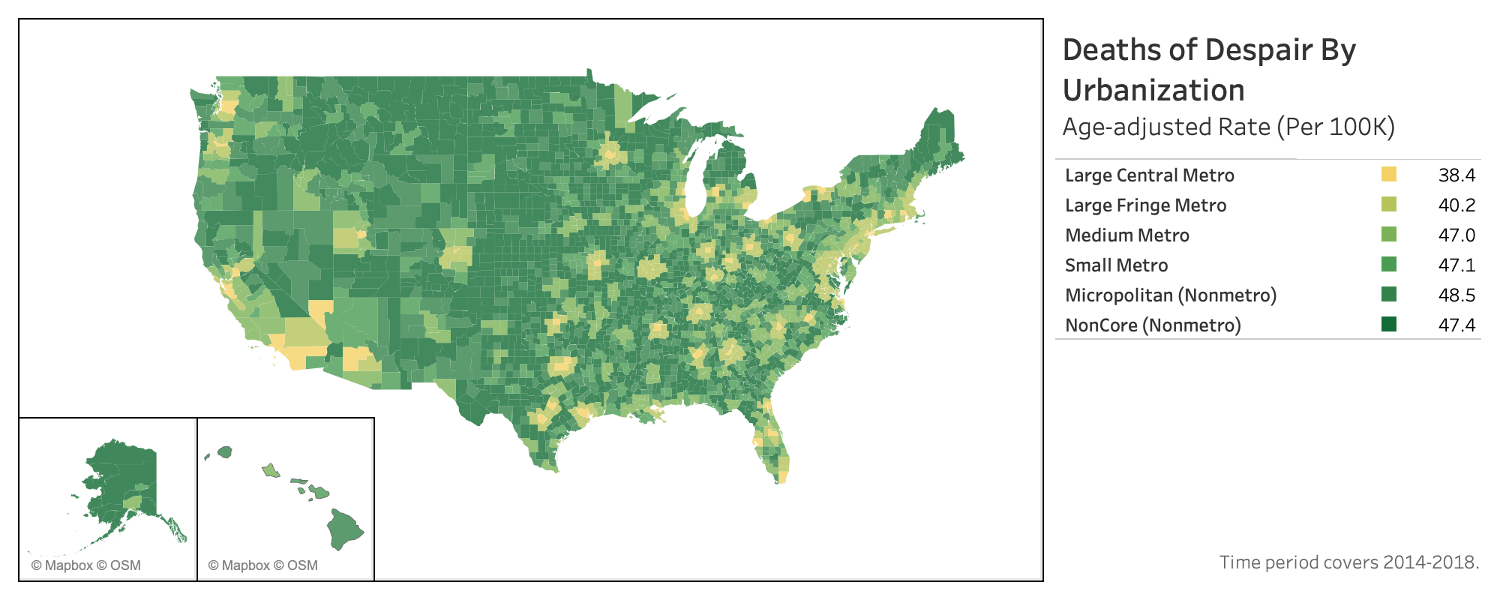
(You can see the locations below. Graying America is navy blue, Native American Lands are bright yellow, and Working Class Country is brown.)

Health Challenges in Graying America and Native American Lands

More travelers to Graying America and Native American Lands could pose special challenges to those places. Both hold populations that are more vulnerable to the virus — older people and those with underlying health conditions.
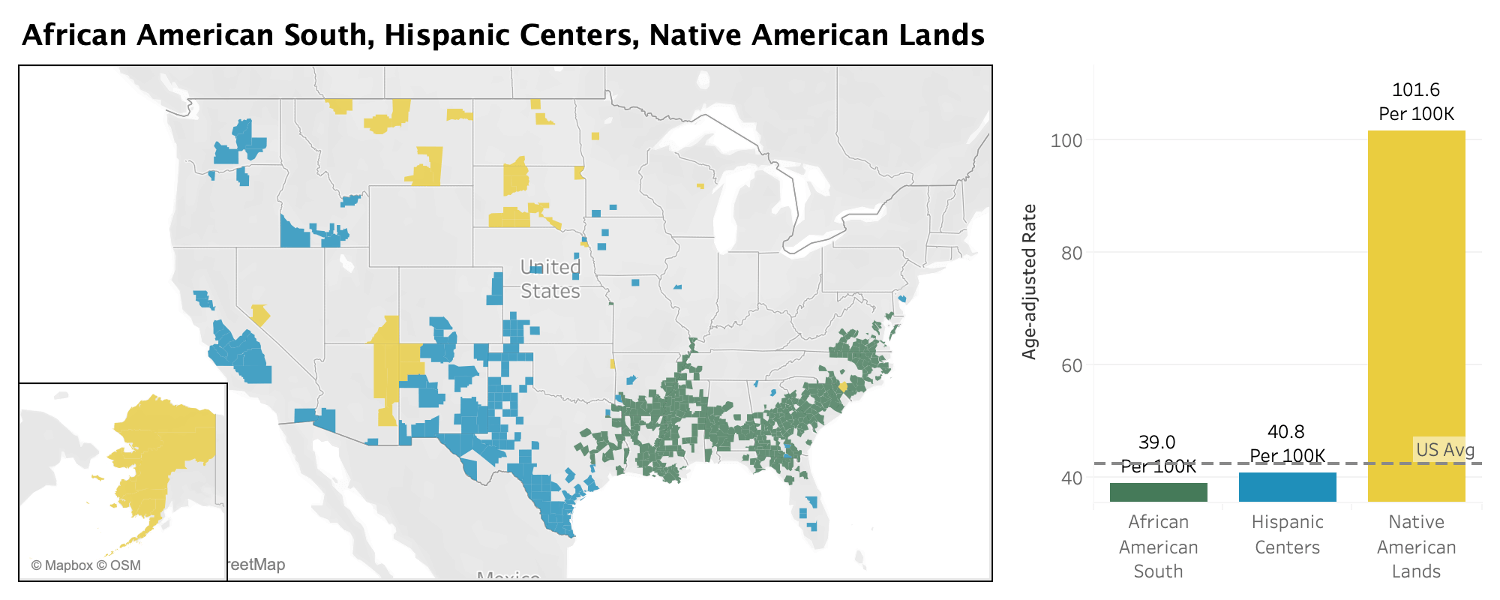
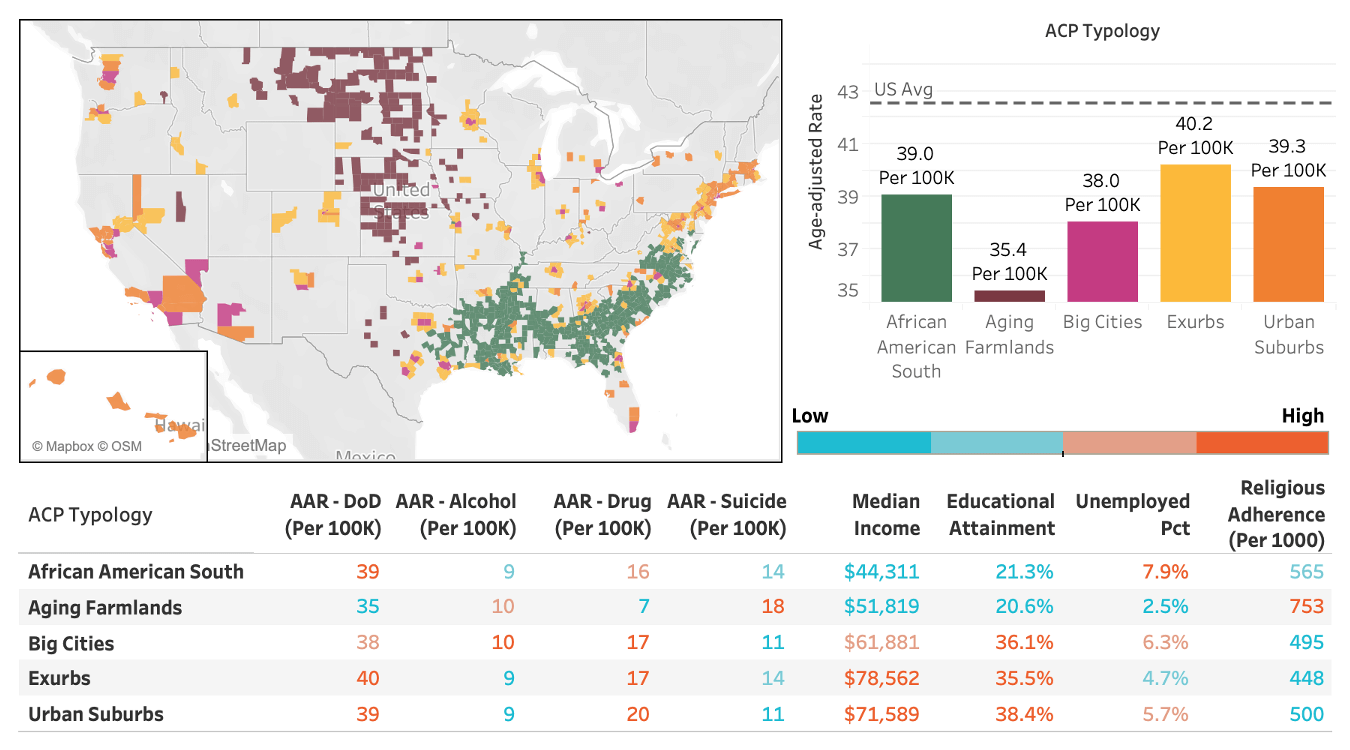
As the name suggests, Graying America stands out by the age of its residents. About a quarter are 65 or older in the median Graying America county compared with the national average of 16%.

The Native American Lands score high for adult obesity, 36% in the median county, and are also high above the national average for uninsured people, 18% in the median county versus a national average of 10%.

On top of those health concerns, both community types have a limited number of ICU beds in case of coronavirus spikes. Of the 364 counties in Graying America, only 135 have any ICU beds. The numbers are even sparser in the Native American Lands’ 44 counties: Only six have any ICU beds.

Opening to Visitors, Safely

As summer vacation arrives, Native American Lands and Graying America communities face crucial decisions.

Native American Lands are home to Indian reservations, which can make their own rules about visitors. And, of course, any community can tighten restrictions as they see fit. But the high numbers of second homes in both Native American Lands and Graying America mean many of these counties need tourism dollars to thrive economically.

Now they face questions around how far to open the door in welcoming visitors. How do they handle seating in restaurants and capacity levels in stores? How do they weigh the goals of making visitors feel safe as well as socially comfortable?

For that reason, these community types will be important to watch this summer as the Covid story turns to the topic of second waves and hot spots. Graying America and the Native American Lands are in an especially challenging position.

Vol. 3 2020-2021

Deaths of Despair Across America

The American Communities Project is undertaking a 30-month study of Deaths of Despair in its 15 community types.

Learn More