Culture

During Dry January, a Look at Americans’ Alcohol Habits and Attitudes

by Ari Pinkus January 07, 2025

When the U.S. Surgeon General sounded the alarm about the link between alcohol consumption and cancer, it was three days into Dry January, a time when many Americans pause drinking in a step toward healthier living.

This “sober curious” wellness movement has been gaining in popularity beyond Dry January, which originated through the organization Alcohol Change UK in 2013. Sober October started a year later. To cater to a growing demand for alcohol-free drinks, non-alcoholic bars have been popping up around the country, including Binge, the first such bar in Big City Washington, D.C., that opened in February 2023.

The American Communities Project sought to understand alcohol consumption habits in our 15 community types, based on the latest MRI-Simmons consumer research data gathered from households across the country between September 2021 to August 2023, and then broken into the ACP types in fall 2024. Nationally, 62% said they had an alcoholic beverage in the last six months. The figures were lower in a few rural communities, including Native American Lands at 50%, Evangelical Hubs at 51%, Working Class Country at 53%, and the African American South at 54%. In these places, many cultural and religious practices turn residents away from alcohol consumption.

Consumption in the Last Six Months

Of the alcohol consumed in the last six months, distilled liquor was the most cited, by 49% of respondents. The noted rural community types sat much below the average, in the high 30s to low 40s.

By contrast, more than a third, 38%, said they consumed beer/ale in the last six months, while 34% said they drank wine in the same period. Beer/ale drinking was highest in the Exurbs, Urban Suburbs, and Middle Suburbs at 40%, all suburban communities of different socioeconomic circumstances. Interestingly, beer drinking hung around average in the College Towns at 37%. Wine drinking, too, peaked at 40% in the Urban Suburbs, while the nearby Big Cities were close behind at 37%.

Where Purchased in the Last Six Months

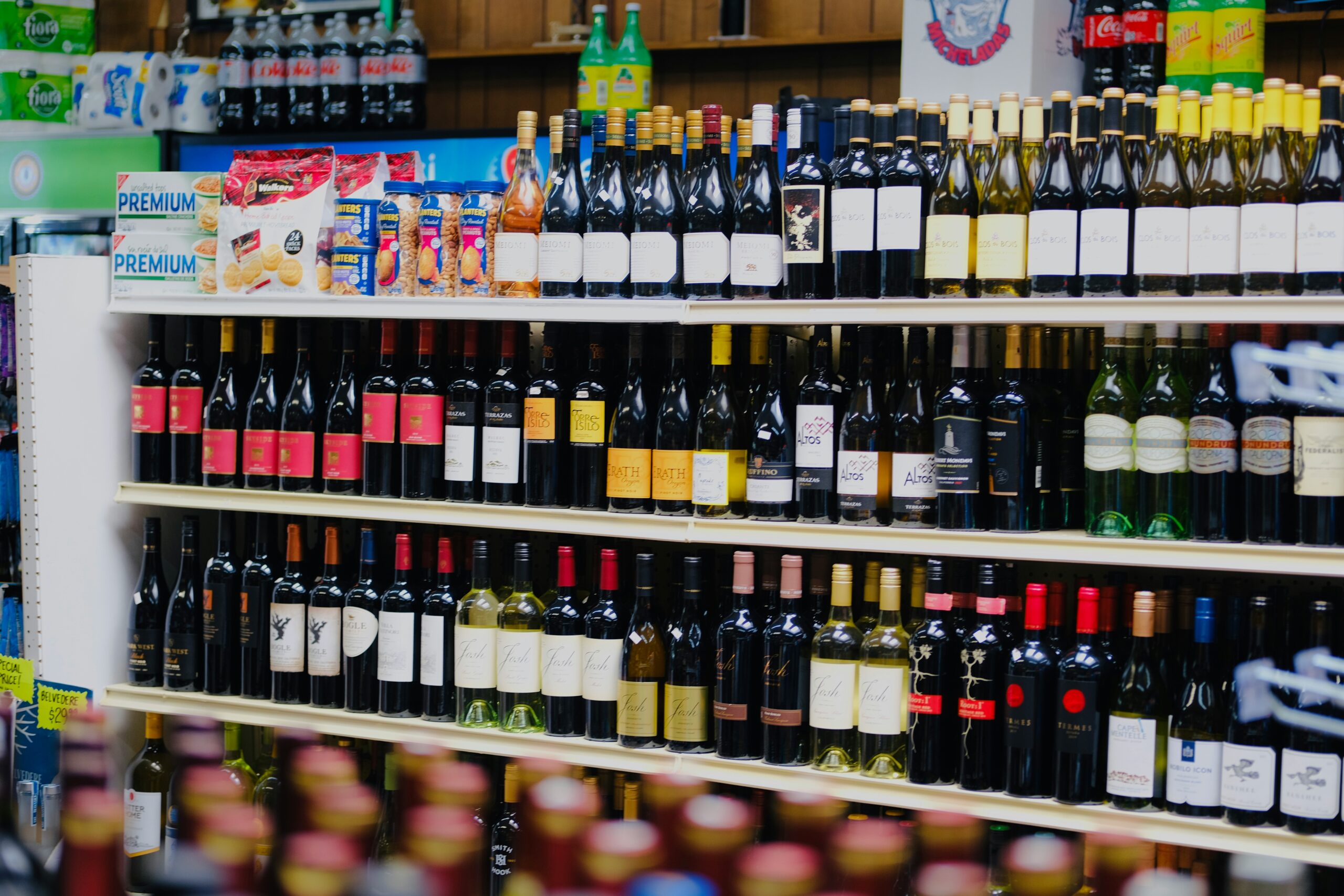
Supermarkets have become principal places for Americans to purchase beer and wine, topping liquor stores, convenience stores, drug stores, membership clubs, online, and other places. Nearly a quarter of household respondents, 24%, said they bought beer from the supermarket in the last six months. Despite the variety of landscapes and lifestyles, this varied just 10 points, from 18% in the African American South to 28% in the LDS Enclaves out West.

Almost a fifth of those surveyed, 18%, said they bought wine from the supermarket in the last six months. The variability among types was just five points. In few rural communities — the Native American Lands, Aging Farmlands, and Evangelical Hubs — 14% said they bought wine from the supermarket in the same period, considered below average.

How Much Spent in the Last 30 Days

When it came to money spent in the last 30 days for beer or for wine, $11-$20 was the range most cited for each kind of beverage. But that covered just 6% of respondents for beer and 5% for wine nationally. Percentages did not vary very much by community. For example, 6% in the Exurbs said their wine purchases fell between $11-$20, which was considered above average for this community type. All other communities were 4% or 5%. For beer purchases between $11-$20, seven community types of different geographies and demographics — Rural Middle America, Urban Suburbs, Exurbs, Middle Suburbs, LDS Enclaves, Graying America, and College Towns — all came in at 7%. Only in LDS Enclaves was 7% considered above average because of the community type’s smaller population size.

For liquor purchases in the last 30 days, the most popular dollar ranges were $11-$20 and $51-$100. Each range sat at 5% nationally. At the community type level, rural communities, such as the African American South, Native American Lands, Evangelical Hubs, and Working Class Country, were considered much below average for such spending. In contrast, the Urban Suburbs stood above average for spending $51-$100.

Wine Drinking in the Last Seven Days

Moreover, drinking domestic wines was more of a habit in the affluent suburbs. Nationally, 8% said they drank four or more glasses in the last seven days. Urban Suburbs stood out for being much above average at 10%. Whereas Evangelical Hubs, Aging Farmlands, and Native American Lands were much below average at 5%.

Nationally, 7% said they drank 2-3 glasses in the last seven days. This moderate amount varied between 4% and 8% at the community level, with Urban Suburbs again at the high end and above average. Aging Farmlands, Evangelical Hubs, Rural Middle America, Working Class Country, and Native American Lands were all considered below average.

Nationally, 14% said they drank 0-1 glasses of wine in the last seven days. Urban Suburbs stood above average at 16%. Rural communities were below average, around 10% or 11%.

A Hard Seltzer Preference

When Americans were asked about consuming drinks or glasses of “alcoholic beverages, coolers & seltzers” in the last 30 days, 8% nationally said they drank four or more glasses. This varied by a few percentage points across the 15 community types, with LDS Enclaves peaking at 10%, which was considered above average.

For brands chosen, White Claw Hard Seltzer, with about 5% alcohol per 12 ounces, came in No. 1, at 23%. LDS Enclaves were at the top end at 31%. In these rural West locales, many Mormon nondrinkers coexist with residents of different lifestyles. Also high were two suburban community types, the affluent Exurbs and struggling Middle Suburbs, both at 29%. Again, the African American South and Evangelical Hubs were at the low end, at 12% and 13% respectively.

Truly Hard Seltzer, containing about 5% alcohol per 12 ounces, came in No. 3 nationally at 14%. There was just 10 points of variation among community types on the question of drinks or glasses consumed in the last 30 days. At the upper end were Hispanic Centers at 18% and the Middle Suburbs at 17%. Meanwhile, the African American South and Native American Lands didn’t reach 10%.

Public Opinion Polling

Overall, public attitudes on alcohol are changing. Gallup has found that Americans increasingly see alcohol consumption as unhealthy, according to the organization’s Consumption Habits poll conducted in July 2024. In fact, “45% of Americans say drinking one to two alcoholic beverages a day is bad for one’s health,” the survey found. That was six points higher than in 2023 and 17 points higher than in 2018, according to Gallup.

Vol. 3 2020-2021

Deaths of Despair Across America

The American Communities Project is undertaking a 30-month study of Deaths of Despair in its 15 community types.

Learn More
Culture

Do Americans Across Communities Prefer Amazon Prime to Local Business Shopping?

by Dante Chinni December 23, 2024

Americans are expected to spend about $1,000 each on holiday gifts this season, according to Gallup, and where they spend that money will have a big impact on communities across the country.

As online shopping increases, small businesses have made a point of asking consumers to “shop local,” emphasizing that local businesses are owned by consumers’ friends and neighbors, and dollars spent there are more likely to have a positive impact on the community.

However, consumer research from MRI-Simmons suggests that messaging is having a limited impact on consumers. That data, broken into the American Communities Project’s 15 county types, shows enthusiasm for shopping locally is tepid at best. Instead, the big winner seems to be Amazon, the massive, national online shopping platform, according to the MRI-Simmons data.

The 15 community types in the American Communities Project are different in a variety of ways when it comes to consumer experiences. The distance to the nearest store, local shopping options, and general product availability are radically different in the dense Big Cities and upscale Urban Suburbs than they are in the sparsely populated Aging Farmlands or small-town Rural Middle America communities.

Yet there seems to be much agreement in the data on local shopping and Amazon.com’s Prime membership.

Local Versus Prime

The first thing that jumps out of the MRI-Simmons data is how uniform it is. Again, considering the differences in the ACP types, one might expect more variation. After all, local business owners are always more likely to be “your friends and neighbors” than the owners of national chains. That is especially true in small towns where fewer degrees of separation exist between locals.

But the survey statement “I prefer shopping at local, independent stores to shopping at national store chains,” shows little difference in the community types.

No community type is below 49% on that statement and no community type is above 53%. That’s a level of agreement the ACP seldom sees, especially on something that can be so tied to a person’s geography.

Some of those numbers might be explained by availability — the stores and products one can find in, say, the Aging Farmlands might dissuade people from shopping locally. But, again, the statement says “prefer.” When considering the close connections in small communities, the relatively low number is still a surprise. It also may be that the numbers in communities like the Big Cities are higher than expected because residents value shopping locally to feel more connected to community in a big urban environment.

Regardless, the largely even numbers across the board are somewhat unexpected.

The figures for Prime memberships show a little more variation, but not as much as one might think considering that Prime is not free. A membership costs $139 a year.

Overall, the Prime numbers do track communities' socioeconomic and cultural differences. For instance, the Urban Suburbs and Exurbs, which have the highest Prime membership numbers, also have the highest median household incomes of all the 15 types. So, Prime’s cost is likely less of an issue for people who live there. And while the membership fee may matter more to people who live in the Native American Lands, Aging Farmlands, and Evangelical Hubs, where incomes are lower, there are also generally fewer shopping options in those places.

Still, the takeaway from the data is that Amazon has a firm grip on the current US consumer experience. There was a time when paying for special conveniences in shopping might have been seen as something reserved for the upper-middle-class and above. These data suggest that is no longer true — or that Amazon has found the right price point for it.

Furthermore, despite a lot of talk of helping small businesses and frustration about empty storefronts, the appetite for shopping locally seems to be limited, even across the varied lived experiences of the ACP.

How Much Do Shared Values Matter?

In a broader sense, those numbers stand in opposition to other findings the ACP has seen in its survey work. For example, the ACP/Ipsos 2023 survey found that residents in every community tended to place more trust in local institutions than national ones. And business was a prime example in every community type.
Far more people said “small or local business” was more likely to share their values than “big business.” (The Aging Farmlands and Native Americans Lands were not included on the small business question due to the time constraints on polling in those places, but other rural communities followed the same pattern.)

How can all these somewhat contradictory numbers be true? Well, first and most important, these results come from different surveys, so different samples and/or methods could have an impact here.

It’s also possible that people in all the ACP community types do feel that local businesses are more likely to share their values, but other issues, such as cost, production selection, and/or convenience, take precedence when making purchasing decisions.

That seems to be a lesson in a lot of big stories this year, including the presidential race, where many voters cast ballots for President-elect Donald Trump, even while expressing reservations about doing so. The reason most people cited for their choice? The economy, particularly inflation.

In other words, values clearly matter to people, but sometimes other concerns may take precedence in the United States in 2024.

Vol. 3 2020-2021

Deaths of Despair Across America

The American Communities Project is undertaking a 30-month study of Deaths of Despair in its 15 community types.

Learn More
Health

Americans Across Communities Want Government More Involved in Health Care

by Dante Chinni and Ari Pinkus December 17, 2024

Washington is about to be hit by a Republican wave. The new GOP leaders arriving in January are promising big changes to many different areas, including health care.

But data from the Associated Press VoteCast election poll, a massive survey of tens of thousands of Americans, show that when it comes to health policy, voters seem to favor approaches that do not follow traditional Republican ideas. In short, voter responses suggest interest in more government involvement in health care, not less, and that is true across all of the 15 community types in the American Communities Project — even those that voted for President-elect Donald Trump.

On four important questions — ensuring Americans have health coverage, lowering the costs of prescription drugs, forgiving medical debt, and ensuring children are vaccinated for childhood diseases — voters in nearly all the ACP’s types said they wanted the government to be “more involved.”

As we have noted on the ACP site since November, even though the presidential race was close nationally, Donald Trump carried the vote in 11 of the 15 ACP community types and did so by double-digits in each.

But the VoteCast numbers around health are raise questions about what exactly Americans are looking for from their new Washington leadership and, in some sense, questions about what the left/right policy breakdown looks like in United States as it heads into 2025.

Ensuring Coverage

Ever since the passage of the Affordable Care Act (aka Obamacare), Republicans have talked about repealing it or repealing and replacing it. If the new GOP majority wants to pursue that strategy, they might want to come back with something that provides at least as much coverage for Americans — and probably more — according to the VoteCast data.

In 14 of the 15 ACP community types (all but the Native American Lands, where uninsured rates are high at 17%), more voters chose the answer “more involved” on the question of how involved the government should be in “ensuring that Americans have health care coverage.” That includes 10 of the community types that voted for Trump.

The numbers were highest in community types that tend to lean Democratic — the African American South, Big Cities, Urban Suburbs, and College Towns. But more than 50% chose “more involved” in Trump-voting communities such as the Exurbs, Middle Suburbs, and Military Posts.

And in every type, “more involved” and “about the same” together received more responses than “less involved,” suggesting there isn’t a lot of appetite for lessening the government’s role in ensuring coverage.

Prescription Drugs

Similarly, a clear majority of residents in all 15 community types said they want the government to be more involved in lowering the cost of prescription drugs, according to the survey. More than 70% of residents in 14 community types — every type but the Aging Farmlands — agreed with this view.

Such coalescing is notable given the range of mindsets, backgrounds, generations, lifestyles, and terrains that exist within America’s immense geographic landscape. The African American South, where diabetes and other chronic diseases are prevalent, hit 80%. Aging Farmlands, sparsely populated, mostly white, older communities in the Central and Great Plains, where an individualistic spirit runs deep, were at the low end at 60%.

Price increases for prescription drugs are routine in the U.S. There were 4,264 drug products that increased in price from January 2022 to January 2023, according to the U.S. Department of Health and Human Services. “For those drugs with a price increase, the average increase over the January 2022 to January 2023 period was 15.2%,” according to HHS.

The federal government has started providing more support for certain groups. As part of the Inflation Reduction Act of 2022, Medicare drug plans for those 65 and over are not permitted to charge more than $35 for a one-month supply of Part D-covered insulin. What’s more, 10 prescription drugs covered under Medicare Part D have been selected for price negotiation, scheduled to take effect January 1, 2026. Several kinds of communities across the ACP are senior-rich, including Graying America, Aging Farmlands, the African American South, Working Class County, Evangelical Hubs, and Rural Middle America.

Medical Debt

Medical debt is seen as a significant issue in American health care as well. At least 50% of residents in all 15 types said they want more government involvement in forgiving medical debt, according to the survey. Aging Farmlands and LDS Enclaves based in the interior West were at the low end, at 50% and 51% respectively. Majorities who want more involvement were found across communities of diverse populations.

Medical debt is a particular pain point in the South, in both attitudes and experiences. Most glaringly, 67% of residents in the African American South said they want more government involvement in this area. In Evangelical Hubs, also concentrated in the South and solidly Republican, 60% felt this way. Southern counties stand out for having larger shares of medical debt in collections, as chronicled by The Urban Institute.

To date, seven southern states — Tennessee, South Carolina, Georgia, Mississippi, Alabama, Florida, and Texas — have not expanded Medicaid “to nearly all adults with incomes up to 138% of the Federal Poverty Level” as permitted under the Affordable Care Act, according to the KFF.

Vaccines

Vaccines are another hot-button issue in health care policy that Trump and voters weighed in on recently. In an interview on NBC’s “Meet the Press,” Trump said he’d consider eliminating childhood vaccines “if they’re dangerous for the children.”

The VoteCast data on this question are not as easy to unpack. In nearly every type (all but the Native American Lands, again, where government distrust seems to run deep), a plurality says they want the government more involved in “ensuring that children are vaccinated for childhood diseases.” But the left/right divide shows up a bit more on this question. Community types where the “more involved” number is at 50% or more are the types that voted for Democrat Kamala Harris in November — plus the Hispanic Centers.

And the lowest “more involved” numbers, come from the more rural ACP types that lean Republican. Along with the Native American Lands, the Aging Farmlands, Graying America, LDS Enclaves, Rural Middle America, and Working Class Country types are all at 45% or fewer choosing “more involved.”

To be clear, the vaccine question is complicated and could be read differently by people and in different communities. For instance, some voters may want the government more involved so that there are fewer vaccines recommended. It’s impossible to know without going out and talking to voters on the ground.

Overall, however, it’s surprising that communities that lean Republican support more government involvement, even if that support is only a plurality of voters. Those wanting the government “less involved” only reaches 30% in two community types, the Aging Farmlands and LDS Enclaves.

The Broader Meaning

The biggest takeaway from these four survey questions may be that, on the issue of health care, Americans want government to have a significant role — even in places the ACP knows are very politically conservative. That’s a departure from conventional wisdom.

Some of the support for more government involvement in these Republican-leaning communities may be tied to changes the GOP has seen under Donald Trump. The president-elect can be difficult to read and erratic, but many of his approaches on policy involve government doing more, not less — everything from tariffs and industrial policy to social issues.

In other words, whatever one’s feelings about Trump and his policies — and the man is clearly divisive — he often tends to call for a more activist government. And that may be impacting how Republicans see government’s role in their lives.

What all this will mean in his second time in office is far from clear. The Trump transition team is also talking about big government cuts. But that broader idea of Republicans supporting government as a tool could have long-term impacts as the nation continues on what appears to be a broader political realignment.

And in a deeply divided country, the idea that people in nearly all the ACP types support an active role for government in their lives — at least around health care — suggests there could be some surprising areas of agreement.

Vol. 3 2020-2021

Deaths of Despair Across America

The American Communities Project is undertaking a 30-month study of Deaths of Despair in its 15 community types.

Learn More
Politics

Most Community Types in America Favor Continuing Support for Ukraine

by Dante Chinni December 09, 2024

President-elect Donald Trump won his return to the White House promising bold changes, including changes in U.S. policy toward the war between Russia and Ukraine, which he said he could end quickly.

What the Trump policy will look like is unclear, but results from the AP VoteCast survey conducted around the election showed most Americans, 55%, are in favor of continuing aid to Ukraine in the fight.

Within the American Communities Project’s 15 types, the views are more mixed — some in favor, some opposed — but there is still strong support for aiding Ukraine. In 11 of the 15 types, more people favor continuing aid than ending it, and that includes some places that went for Trump, even by large margins.

Considering the divisions in the electorate on a host of issues, the 55% support for continuing aid to Ukraine is noteworthy, particularly since Trump, who won, did not profess support for the aid. And the support for Ukraine aid covers a range of different kinds of places. (Note: The community types that voted for Trump are in ALL CAPS below.)

In a range of different community types, a majority of those surveyed said they “somewhat” or “strongly” favor keeping aid flowing. In the Big Cities, Urban Suburbs, College Towns, and African American South, all of which voted for Democrat Kamala Harris, majorities were in favor.

But there was also solid support in the Exurbs, Graying America, LDS Enclaves, and Military Posts. Trump won all those community types by more than 10 percentage points, and they all favor continuing aid to Ukraine by five percentage points or more.

The Military Posts are particularly interesting on the Ukraine issue. They are full of people who know the costs of war and people who get sent to global hot spots when the United States enters conflicts. The fact that voters in the Military Posts favor continuing Ukraine aid by 10 percentage points suggests that those with experience and, potentially with “skin in the game,” see the value in the current U.S. government strategy in the region.

Among the four community types that oppose continuing aid — the Aging Farmlands, Evangelical Hubs, Middle Suburbs, and Working Class Country — there are some notable similarities. All of them voted for Donald Trump by double-digits and none of them are a part of the larger American metropolitan culture that has experienced economic growth over the past few decades.

Three of the community types are predominantly rural. And the one that is not, the Middle Suburbs, has struggled during the last 20 years economically compared with other urban places.

Those four community types may feel a greater need for the nation to focus on “issues closer to home” as the war drags on in Europe — part of Trump’s pitch to voters.

Still, the relative strength of support in VoteCast for continuing aid to Ukraine suggests ending that aid may come with some political consequences.

As the ACP noted recently, Trump’s 2024 win seemed to be largely powered by voters’ unhappiness with the economy, not necessarily support for other Trump proposals. And the president-elect’s narrow popular vote win, a margin of about 1.6 percentage points, doesn’t leave a lot of room for losing support.

Vol. 3 2020-2021

Deaths of Despair Across America

The American Communities Project is undertaking a 30-month study of Deaths of Despair in its 15 community types.

Learn More
Diversity

What Voters Say About Racism in America

by Ari Pinkus December 03, 2024

“When the architects of our republic wrote the magnificent words of the Constitution and the Declaration of Independence, they were signing a promissory note to which every American was to fall heir. This note was a promise that all men, yes, Black men as well as white men, would be guaranteed the unalienable rights of life, liberty and the pursuit of happiness. It is obvious today that America has defaulted on this promissory note insofar as her citizens of color are concerned….,” said the Rev. Dr. Martin Luther King Jr. in his “I Have a Dream” speech, delivered to a crowd of about 250,000 at the Lincoln Memorial on Aug. 28, 1963.

Sixty-one years after King’s iconic speech, 32,000-plus registered voters across the country answered a question about the seriousness of racism in the U.S. today as part of AP VoteCast’s survey during the 2024 election. Notably, a majority in each of the American Communities Project’s 15 types said that racism is a “very serious” or “somewhat serious” problem in the country. (The other options were “not too serious,” “not at all serious,” and “don’t know”.)  In rural, mostly non-Hispanic white, often religious community types like the Aging Farmlands, LDS Enclaves, and Evangelical Hubs, the percentages stood at 51%, 58%, and 59%, respectively. These were the lowest percentages among the 15 types. Aging Farmlands and Evangelical Hubs also voted for Donald Trump in the highest percentages of the 15.

Percentages who said racism is "not too serious" ranged 23 points, from 15% in the African American South to 38% in the Aging Farmlands. Between 7% and 14% in the community types said "not at all" serious, with Evangelical Hubs at the high end.

Perhaps not surprisingly, in the African American South, 272 rural southern communities where the median African American population is 43%, the percentage who felt racism is “very serious” or “somewhat serious” reached 77%. Other diverse communities with many people of color, including the 48 Big Cities, Urban Suburbs, Hispanic Centers, and Native American Lands, the percentages who said racism is a “very serious” or “somewhat serious” problem was in the 70s. In College Towns, where 10% of the population sits between 20 and 24 years old and part of the most racially and ethnically diverse generation, 72% said racism is very or somewhat serious.

To drill down further, 39% of voters in College Towns said it is a “very serious” problem. In more diverse communities — the African American South, Big Cities, and Native American Lands — the "very serious" percentages climbed into the 40s and near 50%.

Consider that Merriam-Webster’s Dictionary (the most popular dictionary in the U.S.) defines racism as: “a belief that race is a fundamental determinant of human traits and capacities and that racial differences produce an inherent superiority of a particular race” “also: behavior or attitudes that reflect and foster this belief: racial discrimination or prejudice.”

On the behavior point, AP VoteCast also asked participating voters about racism in policing. A majority in 14 of the 15 community types said it was a “very serious” or “somewhat serious” problem in America. Only Aging Farmlands, among the most sparsely populated communities, came in below, at 42%. Overall, the percentages who said racism in policing is a “very serious” or “somewhat serious” problem were slightly lower than those who said that racism in general is a very or somewhat serious problem. The exception was the Native American Lands, where the percentage for racism in policing dropped to 58%, from 72% on the broader racism question. The African American South and the Big Cities, where there have been many high-profile examples, the percentages were at the high end, at 74% and 72% respectively.

Discussing Racism and Diversity, Equity, Inclusion Initiatives

While the 2024 election results were highly fueled by voters’ economic pain, racism and diversity, equity, inclusion (DEI) initiatives to address it especially after George Floyd's murder have been and continue to be in the issue mix, as the survey results and ongoing discussions show. In the coming weeks, Christopher Rufo, a writer, filmmaker, and conservative activist, plans to meet with President-elect Donald Trump and his team about DEI initiatives. As The Wall Street Journal's Douglas Belkin reported last week: “His stated goal: make America a colorblind society by eliminating rules that mandate behavior or special treatment according to race.”

Meanwhile, Rev. Al Sharpton recently approached the issue from a different angle, probing how much misogyny and race had an impact on Kamala Harris’s election loss. “Are we overlooking some of the things America still has to grapple with and grow into?” Sharpton asked Democratic National Committee chairman contender and former Maryland Gov. Martin O’Malley on MSNBC’s “Morning Joe” last week.

O’Malley answered: “I think all of those are factors….We’re not yet the perfect union, are we? There’s a lot of…scars that come along with our painful, 300-year history.” He added that the Democratic Party needs to do a better job protecting voting rights. "What does it say about us as a Party that we'll only go into court in swing districts in swing states to defend voting rights?"

While communities all across the country make clear that racism continues to be a national problem, what this means and what follows in order to realize America’s promise remain open questions for Americans to work out next.

Vol. 3 2020-2021

Deaths of Despair Across America

The American Communities Project is undertaking a 30-month study of Deaths of Despair in its 15 community types.

Learn More
Culture

Americans’ Feelings and Behaviors Highlight Connection and Its Limits

by Ari Pinkus November 26, 2024

Amid America’s political frictions and loneliness epidemic, our recent ACP/Ipsos survey revealed a bright spot in Americans’ social lives: Across communities, people reported feeling connected to family or friends most days.

The American Communities Project and Ipsos asked 5,312 residents across the ACP’s 15 types how many days in the past week they felt connected to family or friends and how often they felt lonely. Overall, Americans said they felt connected to family or friends five out of seven days a week and felt lonely 1.2 days a week.

Feeling connected to family or friends was relatively uniform among the community types, but two very sparsely populated communities separated themselves from the pack. In the Aging Farmlands and Native American Lands, people reported feeling connected with family or friends 5.9 days and six days, respectively. Family roots run deep in both places, perhaps explaining this increased connection. Most community types hovered around the five-day average. A weak spot was found in the College Towns, where community members reported being connected to family or friends just 4.7 days in a week, highlighting the age-old longing college students often feel but also how the social isolation of the pandemic continues to affect these communities.

Seeing Friends Frequently

On the specific question of socializing with friends face-to-face, 43% nationally said they spend time with friends in person at least weekly. But the differences on frequent in-person contact were vast at the community level, with a 27-point variation across the ACP’s 15 types. The rural-urban-suburban divides were not clear-cut. Again, Aging Farmlands and Native American Lands saw the highest levels of face-to-face socialization on at least a weekly basis, at 61% and 60% respectively. But Evangelical Hubs, rural, homogeneous communities in the South, came in last at 34%, with Working Class Country in Appalachia and the South just ahead at 37%. College Towns stood below average at 40%. In densely populated Big Cities, 46% of residents said they spend time with friends in person at least weekly, a higher rate than in other suburban and rural communities. (Spending time with friends on at least a monthly basis jumped to 65% nationally.)

Majority Engage People on Social Media

In contrast and not surprisingly, much more regular connection takes place via social media. Overall, 56% of Americans said they message or talk with others via social media at least weekly. While most communities were around 50% or above, Aging Farmlands and Middle Suburbs were well above the average, at 69% and 64% respectively. (Messaging on social media on at least a monthly basis was 65% nationally.)

Attending Community Events Less Frequently

At the community level, about one-fifth of respondents nationwide, 19%, said they attend a community event at least weekly. The 21-point range across communities was equally stark, but the urban-rural divide was not. In the LDS Enclaves, with a high percentage of regular churchgoers, young families, and youth, a high of 36% of respondents said they attend a community event at least weekly. Aging Farmlands and youth-oriented Native American Lands were just behind, in the low to mid-30s. The low point was the Middle Suburbs at 15%, with Urban Suburbs just ahead at 16%. Hispanic Centers and Big Cities, on opposite ends of the rural-urban spectrum, were at 17% and 18%, respectively. In most community types, the percentages were in the 20s. (Attending a community event on at least a monthly basis nearly doubled to 36% nationally.)

Not Often Volunteering in One’s Community

Volunteering was the least popular activity people engage in regularly. Just 10% nationwide said they volunteer in their community at least weekly. Like other in-person social activities, LDS Enclaves, Aging Farmlands, and Native American Lands stood out from the pack with percentages in the upper-teens to upper-20s. (Volunteering on at least a monthly basis nearly doubled to 19% nationally.)

Vol. 3 2020-2021

Deaths of Despair Across America

The American Communities Project is undertaking a 30-month study of Deaths of Despair in its 15 community types.

Learn More
Culture

Keys to a Good Life for Americans: Relationships, Local Commerce, and Civil Society

by Ari Pinkus November 20, 2024

What impacts the ability to live a good life? It’s a question long pondered — and answered — through one’s lived experiences. The American Communities Project and Ipsos asked this question to nearly 5,000 Americans recently to understand where the public stands today. Our findings underscore the significance of personal and local connections as well as a belief in commerce and civil society over government. Drs. Robert Waldinger and Marc Schulz chronicled the centrality of relationships in their 2023 best-selling book The Good Life.

Strongest Roles in a Good Life

In our survey, local enterprises as well as civic, volunteer, or charitable groups emerged in the strongest positions nationally, perhaps because these are well integrated into Americans’ day-to-day, warm interactions with friends, neighbors, colleagues, and community members. Nationally, 60% of Americans said small or local businesses have a positive impact on their ability to lead a good life. This was the highest rate among the options offered; however, Americans did not speak in complete unison and reflected their distinct community cultures.

Across the community types, the standing of small/local businesses in impacting the ability to live a good life ranged 17 percentage points, from 72% in Rural Middle America, known for their collection of small towns, to 55% in the African American South, where daily business is often divided along racial lines. Other diverse communities, too, tended to have fewer residents who felt the connection of local businesses to a good life, including Big Cities and Hispanic Centers, at 56% and 57% respectively. Nationally, 5% said small or local businesses have a negative impact, while 33% said they have no impact. These mostly positive figures also reaffirm findings in our 2023 survey when Americans said small or local businesses were the most likely of major institutions to share their values.

The Impact of Civic, Volunteer, or Charitable Organizations

Coming in second in positively impacting the ability to live a good life were civic, volunteer, or charitable organizations. Nationally, 54% said these organizations have a positive impact. There was little variability among the community types, with nearly all sitting in the low- to mid-50s. The standout was the LDS Enclaves, Mormon strongholds in the interior West, at 63%. Only 6% nationally said civic, volunteer, or charitable organizations have a negative impact, and 39% said they have no impact, similar to beliefs held about small/local businesses.

The Importance of Church or Religious Organizations

Church or religious organizations had the next highest percentage in positively impacting one’s ability to live a good life, at 48% nationally. The 19-point variability in the community types echoed that of small/local businesses. In the African American South and Working Class Country, 60% and 61% of respective residents held this view. In a corresponding finding, 54% of African American South residents and 50% of Working Class Country residents reported that their faith/religion gives them hope no matter what is happening in their lives — the two highest levels of the 15 ACP types. In the Big Cities, where residents are less likely to identify as religious, 42% said church or religious organizations positively impact their ability to live a good life.

Notably, 13% of Americans nationally said religious organizations have a negative impact on living a good life. Some of this negativity may be due to the overall decline of religious affiliation among Americans, the scandals of various religious groups, and the divisions that have surfaced and deepened in congregations during American polarization. LDS Enclaves had the highest negative rate at 19%. This may come from the non-Mormon residents who must coexist in an LDS-dominated community. Last year, The Washington Post documented the decline of U.S. adults identifying as Mormon.

Local Government’s Role

Overall, 32% of Americans said local government has a positive impact, while 30% said it has a negative impact and 36% said no impact. Knowing someone in local government correlates with more positive views. While just 17% of respondents nationwide said they know an elected official or government worker, 47% of people who know an elected official believe local government is having a positive impact on living a good life.

Like small businesses and civic organizations, local government hits close to home, encompassing a myriad of functions that affect a person’s daily life, including emergency services, public schools, zoning, public spaces, libraries, property taxes, and infrastructure. But faith in commerce comes before faith in government. Notably, in our 2023 survey, more than a third of Americans said their community infrastructure was in poor condition, and about a quarter said it was underfunded. Last year’s survey also found that nearly 40% of Americans said their public school system was underfunded, and more than a quarter said it was understaffed. In addition to ongoing funding challenges, local schools and libraries across the country have been in the crosshairs of cultural change these past few years.

National Businesses

According to survey respondents, rounding out the top five kinds of organizations that positively impact one’s ability to live a good life were national businesses, at 23%. Nationally, 44% said they have no impact. Among the types deviating from the average, the African American South stood out at 52%, perhaps because they are home to fewer national businesses.

Least Positive: Local and National News Media and National Government

The remaining three — local news media, national government, and national news media — came in at positive rates of 20%, 16%, and 10%, respectively. A few trends may explain people’s tepid views of these groups. As the ACP has highlighted, local news outlets have been dwindling year by year. Based on figures from the 2024 State of Local News Report, more than 50% of the nation’s counties have one or no local news outlet in their community. Moreover, whether one is personally connected to someone in the field correlates to seeing a positive impact on one’s life. While just 7% of the 2024 survey respondents said they have immediate family members or close friends who are journalists or work for a news organization, 35% of those who know a journalist believe that local media has a positive impact on living a good life.

Also in the realm of public service, national government and national media have consistently polled at low levels of favorability, so the low percentages of Americans who said these institutions positively affect their ability to live a good life is not surprising. Again, having personal relationships in the field counters these trends and correlates with more positive feelings: 26% of people who know a journalist said the national media has a positive impact on living a good life. Similarly, 25% who know an elected official said national government has a positive impact.

AP VoteCast Survey Results

In the survey from AP VoteCast, the good life question turned on one’s overall trajectory. More than 50% of voters surveyed in nearly all community types reported they were holding steady in their life. The exceptions were the Native American Lands, Aging Farmlands, and Evangelical Hubs, at 46%, 50%, and 50%, respectively.

Falling behind was a big concern, cited by 26% to 39% of voters in all but these three rural community types, where it stood in the 40s.

Scant numbers of voters felt they were getting ahead in life. The percentages were highest in more socioeconomically diverse places: the Big Cities at 16%, followed by the Urban Suburbs at 14%.

Vol. 3 2020-2021

Deaths of Despair Across America

The American Communities Project is undertaking a 30-month study of Deaths of Despair in its 15 community types.

Learn More
Politics

This Presidential Election, Voters Across Communities Sent a Loud Message of Economic Pain

by Dante Chinni November 11, 2024

The great race to explain the 2024 presidential election is on. How did Donald Trump re-capture the White House? Was it young men? A shift in the Hispanic vote? Was it the gender divides? The culture wars?

The votes are not all tallied yet, but the American Communities Project’s 15 county types offer some possible answers and one big clue — unanimity. Across all the types there was a rightward tilt compared to 2020’s results, and that at least suggests an answer: It was the economy.

(Before going any further, this is a preliminary analysis from the results as of 12 p.m. ET on November 10. As more votes are tallied in the coming days, these figures will move to some extent.)

As we have noted in past work, the 15 types that the Project studies are complicated and often divide around issues of culture, but on economics there tends to be more common ground. And in the large-scale surveys the ACP conducted in 2023 and 2024, inflation was singled out as the top issue across the board. Even though the number of people who said inflation was their top worry declined in many places in the 2024 survey, it remained No. 1 overall on the list of concerns.

Furthermore, data from AP VoteCast, a survey of voter attitudes conducted around Election Day, offered more evidence that the economy and inflation were the crucial, deciding issues in the 2024 campaign in the ACP’s 15 community types.

Harris Changes

Let’s start by looking at how Vice President Kamala Harris performed in each of the types compared to President Joe Biden’s 2020 numbers — again using the preliminary data.

The above chart shows how Harris underperformed Biden in every type — except the LDS Enclaves — by small and, in some cases, larger amounts. The big drop in the Big Cities category, almost 4.5 percentage points, may narrow as the vote tallies rise and counties like Los Angeles come in. But her number will almost certainly be down compared to Biden’s 66.6% in 2020. She didn’t get what she needed out of those 48 counties that hold more than 80 million people.

The Hispanic Centers showed an even bigger decline for Harris, a 6.5 percentage point drop. That follows the larger story from the 2024 campaign that Trump made inroads with Hispanic voters. But keep in mind that number may move some as well once California’s tallies are final.

More troubling in the results for Harris may be the African American South, where she did about 2.2 points worse than Biden did in 2020. Most of that vote has been counted by now so those numbers aren’t likely to move too much.

Trump Changes

For Trump, the numbers showed gains in every community type.

Of course, the data are the mirror images of Harris’s numbers in many ways — big gains in the Big Cities and Hispanic Centers. But note the nearly two-point gain in the Middle Suburbs, the blue-collar counties around the Industrial Midwest. Those shifts were important to Trump winning the so-called Blue Wall states of Michigan, Pennsylvania, and Wisconsin.

And Trump’s 3.5% gain in the Urban Suburbs, the big, dense, diverse counties in large metro areas, was also major for him. Those numbers may shift a little when the votes are fully tallied, but you can see the impacts in some states. Harris still won the Urban Suburbs, but little chips in her margin in some of those places hurt her.

In 2020, Joe Biden won Oakland County, Michigan, and Montgomery County, Pennsylvania, two big Urban Suburbs, by 14 points and 26.2 points, respectively. In 2024, Harris won them but by 10.5 points and 22.4 points, a drop of more than three points in each.

Trump also did better in the College Towns in 2024 than he did in 2020. He still lost these places, but by less and margins matter.

If the election results were truly driven by cultural issues, rightward movement in those Democratic-leaning types would probably be unlikely.

Evidence for ‘The Economy’ in the Data

As noted above, the differences between the 15 community types, from Big Cities to Aging Farmlands, often become clear on issues around culture. The Project’s first survey in 2023 found big differences in attitudes around gender identity, “traditional families,” and firearms.

That same survey found surprising amounts of agreement on issues around the economy. There was, for instance, wide agreement that “the economy is rigged to advantage the rich and powerful” and wide disagreement with the statement “the U.S. government should cut social programs in order to lower taxes.” And unanimous agreement that inflation was the biggest issue facing their communities.

With that as background, where were voters’ minds this election? Very much on the economy according to AP VoteCast and in every one of the ACP’s 15 types.

Nationally, 39% of those surveyed said “the economy and jobs” was their top issue among the options they were given. In some communities, the number was higher (46% in the Evangelical Hubs and Working Class Country), and in some it was lower (35% in the Big Cities), but it was far and away the top issue in all 15 types.

In the mix of issues, immigration was a distant second, at 20%. Although the figure was noticeably higher in the Aging Farmlands at 34%, those places were an outlier in the data. For most of the other community types, between 15% and 25% cited immigration as a top concern.

Abortion was a distant third on the issue list, at 11% nationally. Even the Democratic strongholds — the Big Cities, Urban Suburbs, and College Towns — did not have large numbers citing abortion as the top issue. In those community types, 13% or less named abortion.

Single Most Important Factor

The AP VoteCast survey asked about the top issue in a different way, as well. The survey went through a series of topics and asked voters to identify the “single most important factor” to them.

One thing that’s evident in the responses is respondents didn’t answer the question clearly. The “single most important” factors add up to well above 100%. But even with that caveat, the results are illuminating.

“The future of democracy in this country” received the largest “single most important factor” score, with 50% choosing that answer. “Higher prices for gas, groceries and other items” was second, at 40% nationally. “Abortion policy” was much lower, at 25% nationally.

But the different answers among the types show different focuses in their respective electorates.

For instance, inflation concerns scored higher than democracy in the Evangelical Hubs, Native American Lands, and Working Class Country. The numbers were basically even in many other types, including the African American South and Middle Suburbs.

And even in the types where concerns about the future of democracy drew the biggest share of responses to “the most important factor” question, at least one third of voters in each type said inflation was the biggest factor.

Perhaps more important, supporters of Harris might read concerns about the future of democracy in this country as being inherently tied to the danger of a second Trump presidency. But both Harris and Trump supporters often framed this election as existential. Voters on both sides saw this election as being about “the future of democracy in this country.”

To be clear, this is only a first attempt at sorting through the numbers and trying to understand the messages from the 2024 election. There is much unpacking to do when all the results are tallied. Issues around “culture” may not have been decisive, but they probably moved some votes. And the gender split, particularly among younger voters, seems to be very real in the AP VoteCast and exit poll data.

An early read of the numbers through the American Communities Project typology, however, suggests an election that was ultimately quite close (a margin of 2.4 points nationally and closer in the crucial swing states), and one where inflation and economic concerns nudged voters across the 15 types toward Donald Trump — enough to carry the popular vote and the electoral college.

Vol. 3 2020-2021

Deaths of Despair Across America

The American Communities Project is undertaking a 30-month study of Deaths of Despair in its 15 community types.

Learn More
Culture

How Crime Affects Americans Across Communities

by Ari Pinkus November 08, 2024

The state of the economy, democracy, immigration, and abortion. Those were the most important issues fueling voters in the 2024 presidential election, according to the exit polls. Crime was not at the top of the list.

That may be because violent crime in the U.S. dropped in 2023 after surging — and drawing much media attention — during the pandemic. Overall, the FBI reported a 3% decline in violent crime, with murders down 12%, rape 9%, and aggravated assault 3%, compared to 2022. Meanwhile, property crime in the country dropped 2%, with burglary down 8%, larceny 4%, but motor vehicle theft up 13%. In this time, the 2022 Bipartisan Safer Communities Act took effect, considered the most substantial gun violence prevention law in nearly 30 years that includes enhanced background checks and safe storage requirements.

While crime continues to be amplified in America’s different information ecosystems, it is very much felt at the community level and in some communities more than others, as shown in our survey findings of 4,712 Americans this year.

Violent Crime by a Stranger

Residents nationwide were generally not direct victims of violent crime, our recent ACP/Ipsos survey found. Just 2% said they were personally a victim of violent crime by a stranger in the last year. Most community types were at or below 2%. It ticked up slightly in communities considered more racially, ethnically, and socioeconomically diverse. In the African American South, 4% said they were personally a victim of violent crime by a stranger; the figure was 3% in Military Posts and Hispanic Centers.

When factoring in one’s immediate family, extended family, close friends, acquaintances, and neighbors affected, residents in diverse rural and urban communities reported violent crime by a stranger at higher percentages than average in the past year. Nearly one-quarter of residents, 24%, in Big Cities said they were or knew someone affected by violent crime by a stranger. It may not be surprising as these communities encompass America’s 48 biggest counties, housing more than 81 million people of many backgrounds. Meanwhile, in the rural African American South and Hispanic Centers, 19% and 18% of residents said they were a victim or knew someone who was a victim of violent crime by a stranger. The national average was 17%.

Violent Crime by Someone Known

Across the country, 15% of Americans said in the past year they were a victim and/or had immediate family, extended family, close friends, acquaintances, and/or neighbors who were victims of violent crime perpetrated by someone they knew.

Again, racially and ethnically diverse communities reported more bad experiences. In the African American South, 23% of residents reported being directly affected or being close to someone who was a victim of violent crime by a person they knew. In Hispanic Centers, many near the U.S. border where tensions have been high, it was 18%. In Big Cities, College Towns, and Working Class Country, 17% of residents said they were or knew someone affected by violent crime perpetrated by someone they knew. Working Class Country may be somewhat surprising, being that these are rural, homogeneous, often close-knit communities, however, many are in the South where violent crime has been higher.

On the personal level, 2% nationwide reported being a victim of violent crime by someone known to them. Most community types were at or below the national level. The figures were slightly higher in Military Posts at 4% and the African American South at 3%.

Property Crime Incidences Higher

Property crime was much more prevalent across America in the past year, our survey respondents said. Nationally, 10% of Americans reported they were personally a victim of theft or personal property crime. Being a victim reached as high as 14% in the African American South and 13% in the LDS Enclaves, Mormon-dominated communities in the interior West. Big Cities, College Towns, Hispanic Centers, and Working Class Country were also above average at 11%.

Adding in immediate family, extended family, close friends, acquaintances, and neighbors, 39% nationwide said they were or knew someone who was a victim of theft or personal property crime. The 15-point range at the community-type level was notable, as it underscores the different day-to-day experiences of Americans regarding their safety and sense of disorder. Several communities stood above the national average: 46% of residents in Hispanic Centers, 44% in African American South, and 44% in Big Cities reported they were or knew someone affected by theft or personal property crime. The lowest percentages were in Rural Middle America at 33% and Middle Suburbs at 31%.

Similarly, business property crime was also a significant concern in the past year. Overall, 25% of Americans said they have been the victim or knew a victim of business property crime. It was much above the national average in Hispanic Centers at 32%. Big Cities came in next highest at 29%. It was as low as 16% in the Military Posts.

Police Brutality and Law Enforcement Abuse 

Of all the kinds of crimes surveyed, police brutality or law enforcement abuse was generally not an issue faced personally or in one’s social circles. Nationally, 10% said they were or knew someone — immediate family, extended family, close friends, acquaintances, and neighbors — affected by police brutality or law enforcement abuse. Percentages were highest in the Big Cities at 15% and the African American South at 14%, where these crimes have been chronicled more in the aftermath of George Floyd’s murder in 2020.

On the personal level, 3% in the Big Cities said they were a victim of police brutality or law enforcement abuse. In all other kinds of communities, 1% or 2% said they were personally a victim in the past year.

Where Crime Is a Top Local Issue

These figures track with the top local issues survey respondents cited. For example, 36% of residents in the African American South considered crime or gun violence a top-three local issue, the highest of the 15 types and more than double the national figure. Recall that many residents here said they or those they knew were affected by crime. (Last year's survey showed the figure in the African American South at 43%.) It was similar in the Big Cities, where 26% said crime or gun violence was a top local issue. In other communities where residents reported being close to crime, College Towns and Military Posts, 19% and 18% of residents respectively said crime or gun violence was a top-three local issue. The overall figure for the 15 community types was notably lower at 14%. (Last year, the national figure was 21%.) Our latest survey makes clear that residents’ lived experiences were connected to their attitudes on crime in their communities.

Vol. 3 2020-2021

Deaths of Despair Across America

The American Communities Project is undertaking a 30-month study of Deaths of Despair in its 15 community types.

Learn More
Culture

Americans Across Communities Struggle to Discern Facts on Voting, Crime, Immigration, and Economic Issues

by Dante Chinni October 21, 2024

Ever since the day of the 2020 presidential race, rumors have circulated about illegal votes and cases of voter fraud. And for years now, those rumors have been knocked down as false with no real evidence to support them — again and again and again.

And yet…

In this year’s research survey from the American Communities Project, fewer than four in 10 respondents, 38%, knew those rumors were false. Even in communities that voted for President Joe Biden by large margins, fewer than 50% said they knew the following statement was incorrect: “There are tens of thousands of documented cases of voter fraud in the last election.”

As the 2024 campaign winds down, that incorrect understanding of the election facts is important to keep in mind, but it is by no means the only area where Americans struggle to discern fact from fiction. There were nine factual true/false statements on the survey, covering everything from the economy to immigration to crime. For most issues, a majority of respondents gave the incorrect response. And again, that was true across all types of communities — encompassing urban and rural, diverse and less so, lots and fewer college degrees.

The challenge of knocking down falsehoods has been apparent in recent months as outlandish and unfounded stories have spread about everything from government-controlled weather to immigrants eating pets.

But the results from the newest ACP survey show Americans’ struggles in this area extend beyond hot topics to a range of areas in society. Their responses suggest a deeper problem, a nation locked in a media environment where dis- and misinformation are increasingly difficult to control and combat — or even correct after inaccuracies are discovered.

There are numerous differences in the ACP’s 15 community types, but even in places where people have more education and broader knowledge bases, the inability to identify the correct answers is apparent.

Voting and Elections

The survey presented two statements around elections: One around voter fraud, seen in the opening of this piece (which, again, is false), and one that says the Supreme Court has found it is constitutional to require voters to show identification before they vote (which is true).

In every community type, fewer than 50% of respondents identified these statements correctly — and most community types were not even close to 50% correct on either one.

Some of the expected leanings and biases show in the responses. For instance, communities that tend to vote Democratic — the Big Cities and Urban Suburbs — were more likely to know the “tens of thousands of documented cases of voter fraud” statement was false. And places that lean Republican — Working Class Country, Military Posts, and Evangelical Hubs — were more likely to know that the Supreme Court has found it is OK to request identification from voters.

But in every community type, a majority did not know the correct answer to either of those statements.

The State of the Economy

There are few issues Americans have more direct contact with and knowledge of than the U.S. economy. They know whether they and their friends and neighbors have jobs. They know what they pay when they do their monthly bills or at the supermarket checkout.

And the answers to the statements about economics suggested a more informed group of respondents — at least on inflation.

More than 60% of the people in every community type knew that “inflation remains above historic averages”— something that was definitely true when this survey was conducted in June and July.

But when the statement turned to unemployment, the respondents across communities missed the correct response. Nationally, only 35% knew that the “U.S. unemployment rate was at or near historic lows.” A selection of county types — Urban Suburbs, Exurbs, College Towns, and Graying America — did a little better, with 40% identifying the statement as true. While the right-leaning Evangelical Hubs' “true” answer was much lower, at 24%.

Again, however, the correct answer did not register above 50% in any community type.

Immigration

The issue of immigration is the opposite of the economy. It’s a topic upon which many have opinions, but fewer have direct contact. And that showed in the true/false section of our survey. People seemed to understand the broad facts of the data, but were wrong on the numbers’ implications, at least around crime.

The one statement people answered correctly (true) was “migration across the U.S.-Mexico border is at or near historic highs.” That story has been front-and-center in the media and roughly six in 10 respondents, 61%, got the answer correct. In fact, in every type more than 50% answered correctly, though, again Democratic-leaning places were lower and Republican-leaning places were higher.

But on the immigration statement around crime, not a single community type had more than 50% giving the correct answer. In the Urban Suburbs, 50% correctly said the statement “undocumented immigrants are more likely to commit violent crimes than native born Americans” was false. But that was a rare exception to the larger trend, and it still wasn’t a majority among a group of people that tends to be well-educated and knowledgeable. Furthermore, it is for a statement in which their political leaning probably should have led them toward the right answer.

Crime

And, finally, the survey offered three true/false statements around crime and policing where no community types had a majority giving the right answer. The three statements here were pretty grim — rising rates of killings by police, rising murders in 2023, and an epidemic of child kidnappings. The statements are all false and none of the community types came close to 50% on the correct answer.

Frankly, this finding is something of a surprise. Considering the drastically different worlds these places embody on a variety of topics, the uniformity here is hard to explain. Again, the typical Democratic/Republican divides emerge on these statements: Big Cities were less likely to know that killings by police officers were not rising, and Evangelical Hubs were less likely to know the murder rate fell in 2023. However, the differences were muted — and that may raise a larger point about the country.

Dour Days

To be clear, not all these statements are connected to misinformation or disinformation. Some are simply about people’s general knowledge. But in a larger sense, these results suggest people are not feeling good about the country right now. And that feelings, not facts, seem uppermost in mind.

Consider the fact that eight of these nine statements (all but the Supreme Court prompt) gave the respondent a chance to give a positive or negative response. Is inflation high? Is murder up? Is unemployment low? In every case, the respondents chose the negative response. They believe inflation is high, murder is climbing, and the unemployment rate is not good.

In fact, the two statements where more than 50% gave correct responses in all the community types were also the negative responses. Inflation has been above historical norms and migrations across the U.S.-Mexico border are at or near historic highs. These are true trends, but they are also not good trends, and that may be the primary reason why respondents gave the correct responses on them. The negative views of the respondents aligned with the truth.

And along with an inability to beat down mis- and dis-information, that may be the real story in these responses: the larger pessimistic attitude Americans have about what’s happening in the country in 2024. Given the choice between a positive view and a negative view, Americans seem inclined to take the latter.

That disposition certainly flies in the face of the traditional view of the American psyche built on optimism. The bigger question going forward may be whether our survey presents a one-time finding, reflects a temporary mood, or signals a fundamental shift in the American perspective.

Vol. 3 2020-2021

Deaths of Despair Across America

The American Communities Project is undertaking a 30-month study of Deaths of Despair in its 15 community types.

Learn More