
Manufacturing Jobs Are Not Coming Back. Where and Why That Matters in 2026
LANSING, MICH. – Candidate Donald Trump made a lot of promises in the 2024 campaign on a lot of topics, but a crucial one for blue-collar voters was his pledge to bring back manufacturing jobs.
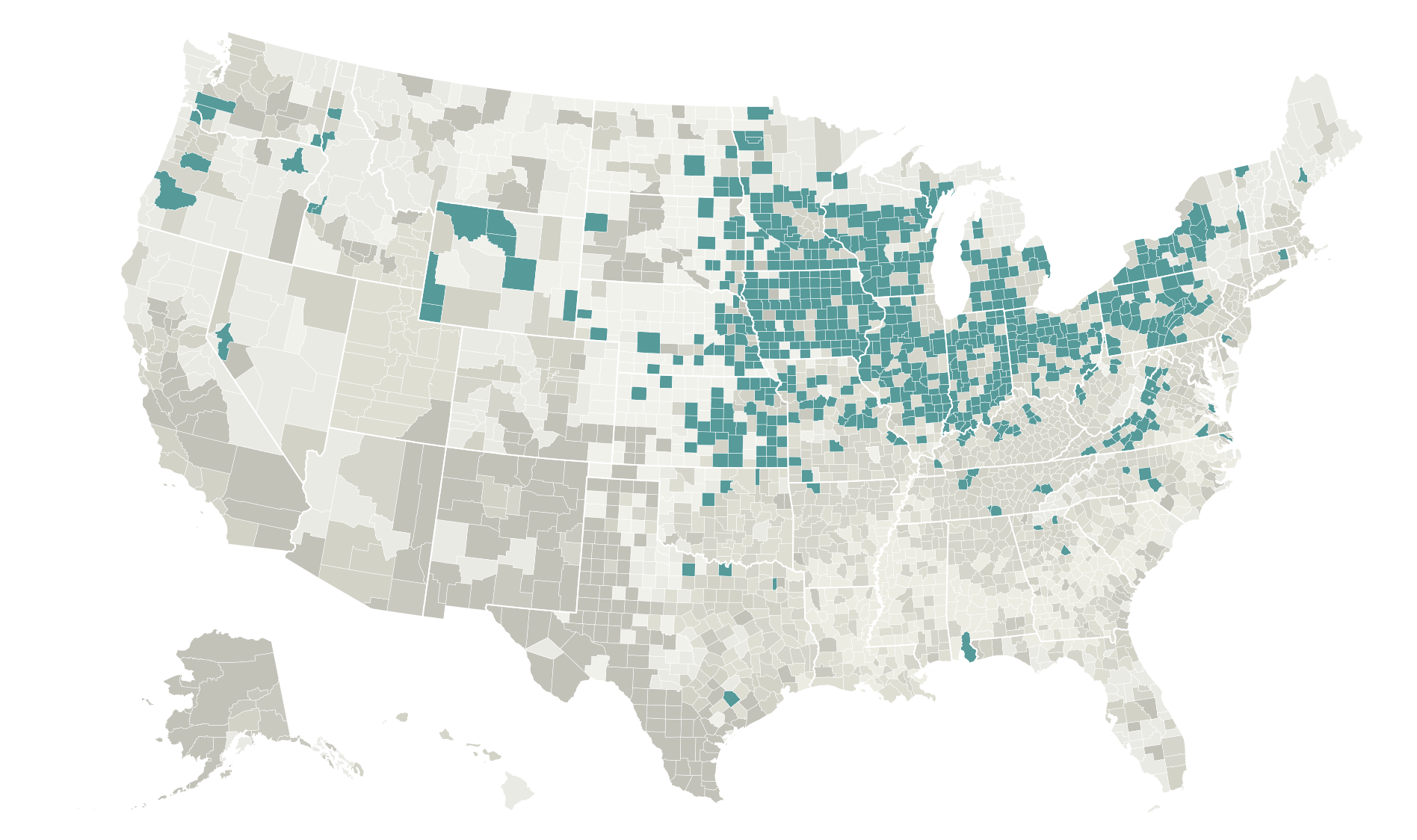
Now, more than a year into his second term, those jobs have yet to materialize and that could have real impacts across the electorate in 2026 — particularly in this state and others like it around the Midwest. The consequences might be felt especially deeply in the blue-collar areas the American Communities Project calls the Middle Suburbs and Rural Middle America.
Middle Suburbs
Rural Middle America
Those two community types rely more on manufacturing jobs than other communities, they are heavily based in Great Lakes swing states with important statewide races in November, and they were a big part of Donald Trump’s presidential wins in 2024 and 2016.
If voters in those places are disheartened and/or disaffected in November, Republicans are likely going to face real challenges at the polls.
Manufacturing and the Michigan Economy
The promise of “bringing back manufacturing jobs” has been a staple of political campaigns for decades. And, generally speaking, manufacturing employment in the United States has steadily declined in that time. Some of those losses are due to facilities moving elsewhere, but a lot of them are due to automation.
Go to an auto factory today and you find assembly lines simply don’t have the same number of people on them as they did 40 years ago — or even 10 or 20 years ago. Fewer are needed.
Many blue-collar voters were hopeful Trump could reverse that trend. Here in Michigan, support from autoworkers helped power Trump’s victory.
But thus far, the Trump administration’s record on manufacturing jobs has been weak. Manufacturing jobs are down nationally and in Michigan since February 2025, Trump’s first full month in office.
The drops are not the “off the cliff” variety — about 98,000 nationally and about 6,000 in Michigan. But they are not increases and certainly not anything to crow about.
Here in Michigan, there are broader signs of economic concern. The latest Michigan Future Business Index, a survey of 500 small- to mid-sized business owners in the state in the last six months of 2025, found economic sentiment lower than it has been in 20 years — worse even than during the Great Recession.
Some key findings:
- Only 13% said they had increased hiring in the previous six months.
- Only 17% said they had increased capital spending.
- Only 25% said they had seen an increase in sales.
According to the survey, one big driver in those data: tariffs. In the survey, 49% of business owners said tariffs had led to an increase in consumer prices, while 37% said tariffs had led to a decrease in profits.
Chris Holman, founder and CEO of Michigan Business Network, which released the survey says businesses are frozen because the size of the tariffs and the way they change has left owners unsure of how to respond.
And Holman says the tariff impact was felt especially strongly among manufacturers. “Nobody is more affected by tariffs on goods coming into the country than manufacturers,” he said.
Blue-Collar Communities
Again, that has a special impact on the communities that rely on manufacturing for a larger share of their jobs, the Middle Suburbs and Rural Middle America.
Together the Middle Suburbs and Rural Middle America make up 36 of Michigan’s 83 counties. They make up 58 of the 88 counties in Ohio. And in Wisconsin, they make up 48 of 72. All three states have gubernatorial elections this fall. Michigan and Ohio also have senate races.
It’s hard to overstate just how important these communities’ turnout numbers and margins are for the GOP in statewide races — especially the Middle Suburbs, which are densely populated and hold a lot of votes.
In Michigan, the Middle Suburbs hold 20% of the population. In Ohio, the figure is 18%. In Wisconsin, it’s 19%. And the vote swings in these places can have an outsized effect on the overall results.
In 2016, Trump won the Middle Suburbs by 13 points and carried Michigan, Ohio, and Wisconsin. In 2020, Trump won those same counties by only 10 points and lost Michigan and Wisconsin. In 2024, Trump won the Middle Suburbs by 13 points again and carried all three states again.
What will happen in those same states without Trump on the ballot to juice Republican turnout and when his approval among independents is down? Especially with those blue-collar communities feeling pain from a weak manufacturing economy, some of which was likely caused by tariffs that Trump pushed?
That scenario may be tested this fall.