
In a Michigan College Town, Housing Worries Boil Over
On a recent Tuesday night, a man in a rumpled suit paced in the back of a small, carpeted room, nervously smoothing back his hair as he watched the scene in front of him.
He was one of several unhoused people from Lansing, Michigan, who had traveled that night to a high-school-turned-community-center in the college town next door. Bringing him to East Lansing — as well as dozens of community members and multiple camera crews — was a prickly and ever-present subject for the entire region: housing.
In contention were two ordinances that critics say criminalized the homeless, and another to approve the construction of a new apartment building.
Other measures were on the East Lansing City Council’s agenda as well, but none had them quite as incensed as these. Surrounding Lansing, where 648 people experienced homelessness on a given night in 2024, it’s an issue that strikes a chord.
For many, it’s a bitter cycle. Some end up on the street. Some — if they can meet the often-strict requirements for entry — enter shelters, though they risk theft and violence. Some flock to alternative models of housing, like cooperative housing units around East Lansing’s Michigan State University, but they can face distrust by their student housemates.
Meanwhile, as rent increases and housing availability remains stagnant, even the students that populate the college town are feeling the strain. A recent survey found that 8.5% of MSU students faced homelessness in the past year, and in 2025, the university reported a 117% increase from the previous year in orders placed through its student food bank.
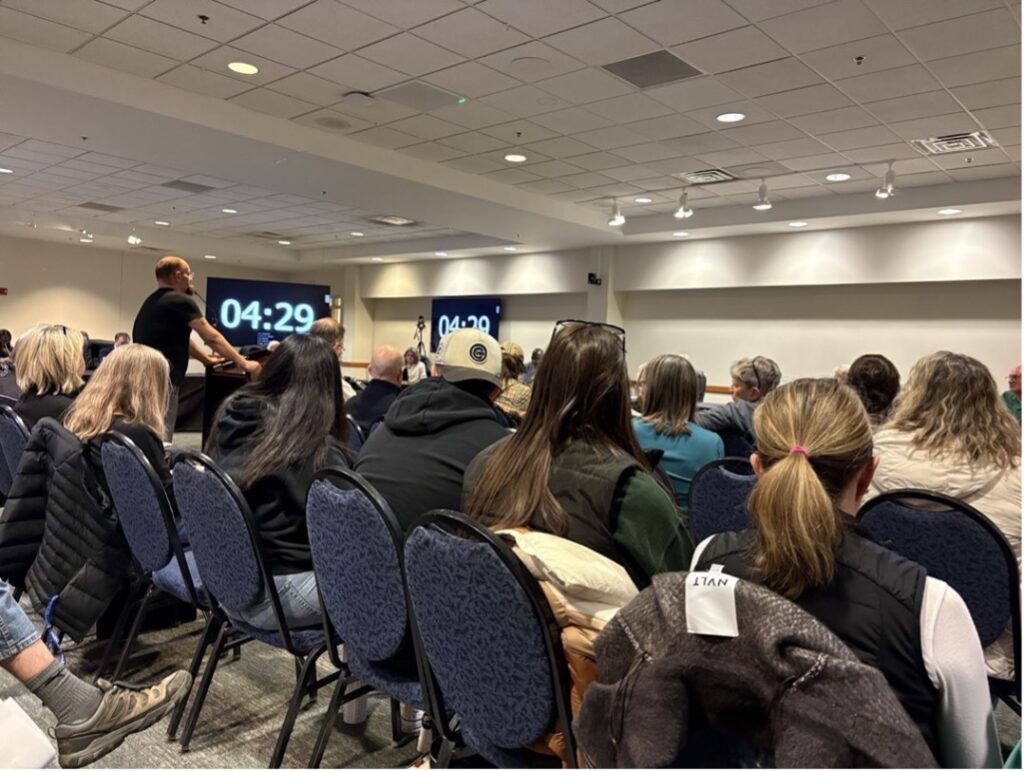
This tension boiled over at the city council meeting on March 17, which ran past midnight and featured hours of emotional public comment from students and the unhoused alike.
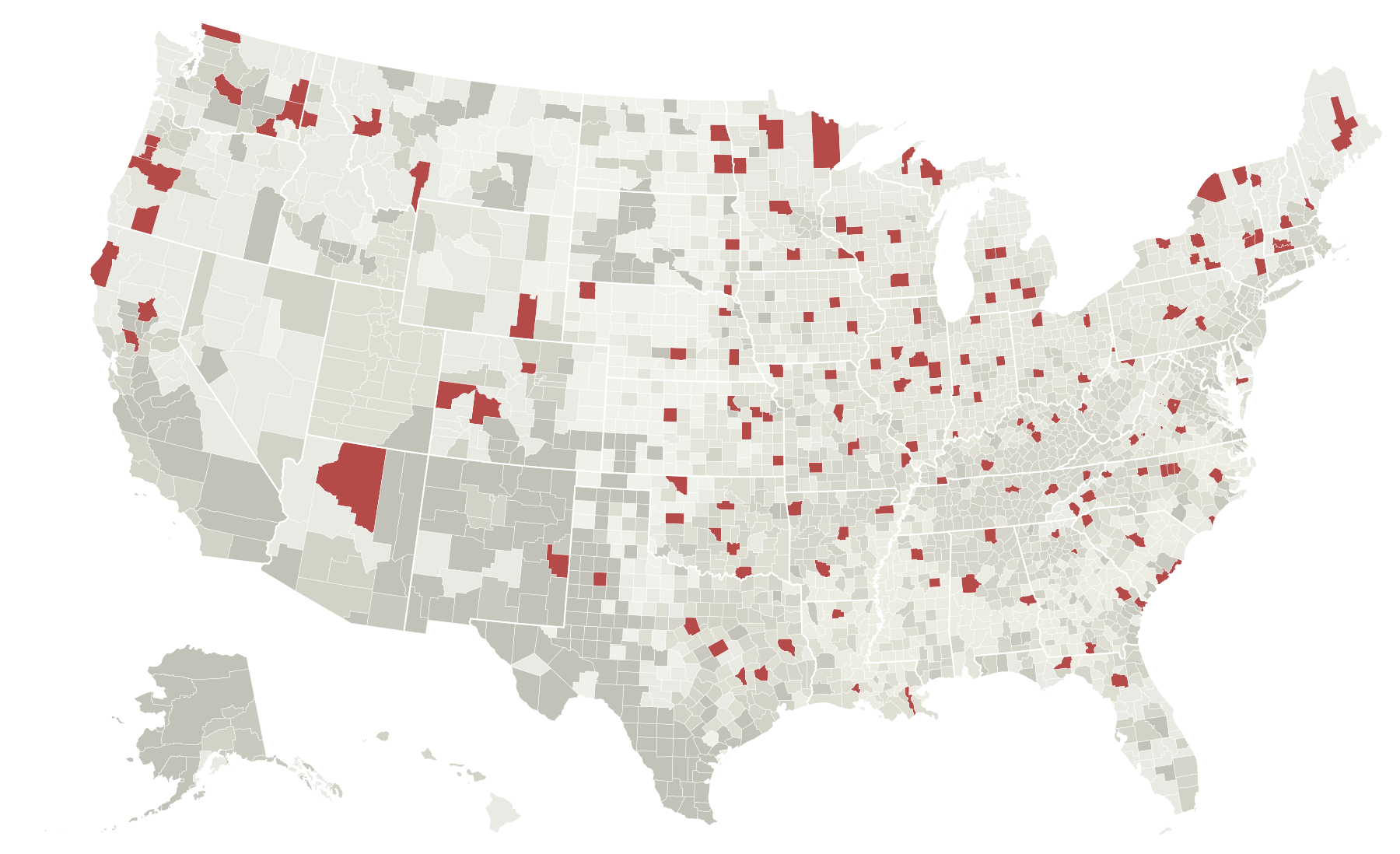
It was a snapshot of what debates over housing look like in College Towns, where 10% of the population sits between the ages of 20 and 24. College Towns count for 171 counties across the country, and are generally located near large colleges and universities.
College Towns
In an American Communities Project survey last year, 27% of College Town respondents put “Homelessness/Housing Insecurity” as one of the most important issues affecting their local communities.
In a small win for the advocates at the meeting, one of the more controversial ordinances didn’t go through. But Ingham County’s housing problem, they say, is far from fixed.
‘We just need that little step forward’
The most controversial ordinance on the table, which broadly banned public camping, had originally been proposed as a way to address off-campus crime, according to East Lansing Info. But over time, it was whittled down to merely allowing police to give out warnings — and, if necessary, a misdemeanor — to people obstructing public events. It included a provision that if the person blocking the event space was identified as unhoused, they must first be referred to a social worker or facility.
Several unhoused spoke at public comment, objecting to the idea that criminalization should have any role while approaching someone during a time of need.
“Criminalizing people for just being poor is not going to solve anything,” said Ron Wright, an unhoused father in Lansing. “We just need that little step forward to be able to build off of, instead of being chased around all the time.”
Wright has become a sort of de facto spokesperson for the unhoused community in recent months. He became homeless himself around two years ago after taking on a second job to pay child support. Overworked, he “burned out” and ended up in the hospital. By the time he got out, he had been evicted from his apartment and his car was repossessed, he said.
Without a home or transportation, Wright eventually made his way to a large homeless community set up in tents near Lansing’s Dietrich Park.
At the time, Lansing was suing two business owners for “allowing” the encampment on their property, hoping to clear the tents. In December, the city agreed to temporarily house 60 Dietrich Park residents in a nearby hotel.
The hotel was “one of the best things that ever happened” to Wright during the ordeal, he said.
Able to shower and shave, he landed a job at Punks with Lunch, a nonprofit that provides resources to the unhoused.
Soon, however, he was making too much money to continue staying at the hotel under the city’s requirements. He doesn’t make enough to find alternative housing, he said, and the eviction and car repossession on his record didn’t help. These days, he sleeps on his employer’s couch.
To Wright, the situation shows that if Lansing wants to provide housing, it should go all in. Placing too many limits on who can stay and for how long defeats the purpose.
It also revealed other flaws in the city’s social safety net: Before losing custody of her and moving into Dietrich Park, Wright and his daughter went from shelter to shelter, he said. No one would take them in except Haven House, East Lansing’s only shelter, due to rules around housing men in family shelters.
In April 2025, two outside firms commissioned by the city of Lansing to conduct a study of homelessness in the area noted that shelter accessibility and suitability “are key challenges for specific populations” in need of housing, such as families, LGBTQIA+ people, and domestic violence survivors.
Many shelters admit residents based on merit or religious affiliation — difficult requirements to fill for an unhoused person, said Amy Stephenson, communications manager of the Michigan Coalition to End Homelessness. The organization argues for a “housing first” approach, which advocates for providing housing without requiring members to prove sobriety or income, Stephenson said.
Trouble at home also drives homelessness. Susan Ayers, who runs Hannah’s House, a small women’s shelter in Lansing, says 87% of the women who stay there have experienced verbal or emotional abuse. While the shelter encourages residents to attend church and take up faith, it’s not required for entry, Ayers said.
Alternative housing
Advocates also point to the underlying factors contributing to housing insecurity: stagnant wages, rising rent, and a lack of available housing.
In Ingham County, 44% of households are below the Asset Limited, Income Constrained, Employed (ALICE) threshold, compared to 41% statewide, according to 2023 data from United for ALICE. Meanwhile, during the past three years, median monthly rents in the Lansing-East Lansing metro area rose 20%, to more than $1,350, according to research firm Construction Coverage.
Increased prices are hitting students, too. A June 2025 survey of more than 1,000 MSU students found that 8.5% experienced homelessness within the past year, and more than 37% faced at least one form of housing insecurity.
While it is commonly assumed college students receive substantial financial support from their parents, that’s changing as the cost of education increases and colleges take in students from more diverse backgrounds, said MSU geography professor Stephen Przybylinski, who conducted the survey with political science professor John Kuk.
Przybylinski and Kuk were inspired to conduct the first-of-its kind survey after noticing rising rates of homelessness among 18- to 24-year-olds in Michigan, and hearing anecdotally about students experiencing housing insecurity at MSU, Przybylinski said.
For months, the East Lansing City Council has batted around plans for additional housing downtown. While some welcome the opportunity to build new units, others worry that the high-end, 13-story apartment building would exacerbate East Lansing’s rental price issues, reshape the area’s skyline, and create parking problems.
The developers hoping to build the project are asking for a tax break to comply with the city’s diverse housing requirement, which they plan to do by lowering prices on a quarter of the units. Some council members expressed interest in lowering the requirement at the city’s March 17 meeting, but ultimately delayed a vote on the project, according to East Lansing Info.
Khadja Erickson, the executive director of the Mid Michigan Tenant Resource Center, said new housing is inevitable — and, as the state deals with a growing housing availability crisis, should be welcomed.
“If you want East Lansing to grow, that necessarily means that you will be adding additional housing,” Erickson said.
MSU student AJ Schicht, on the other hand, is “very weary” that the apartments will become “another way to totally jack up prices in town,” they said.
Schicht is the vice president of membership of the Spartan Housing Cooperative, a collection of cooperative housing units occupied by both students and non-students, some of which have been around since the 1930s.
The organization presents itself as an alternative solution to issues around housing insecurity: change how housing itself works.
Unlike standard landlord-controlled properties, residents have full ownership and control over their housing, Schicht said. As a result, the co-ops have been able to maintain relatively cheap rates.
While most residents are students, the co-ops are open to non-students as well, which can at times be a source of tension, Schicht said. Some non-students, drawn in by the cheap rent, tour a co-op and deem it too “college-y,” while some student residents regard their older, non-student housemates with suspicion, said Vice President of Education Onyx Layne Bromley.
“People of all age groups need cheap housing, not just students,” Bromley said. “And we want to serve our entire community, not just the people who have enough money to go to MSU.”
Jerry Norris, founder of Lansing community center The Fledge, is undertaking a similar effort with the Sunshine House, a cooperative housing unit where residents buy shares in the house and build equity collectively. It’s run on the blockchain, using his own cryptocurrency, FledgeCoin.
The model keeps costs low, Norris said, and residents can reduce them further by contributing labor — like repairs and maintenance — that would otherwise require outside spending.
People struggling to find housing “are not problems,” said Norris, whose organization provides a myriad of resources meant to get locals on their feet. “They’re stored human capital that, if we remove some obstacles out of the way, would make us a lot more powerful, a lot smarter. It would bring a lot of value to the community.”

The vote
At the city council meeting, Wright sat solemnly. His eyes were closed, and his head lowered between his legs as council members debated the first of the two ordinances, which would ban loitering in parking structures.
East Lansing Police Chief Jen Brown explained that the ordinance was intended to reduce crime in parking structures, which she said had doubled in recent months. It was not, she said, about the unhoused: Most of the time, the city sends social workers when that’s the case. The measure passed, 3-2.
Next up was the public camping ban. Even in its reduced form, it seemed, no one wanted to touch the ordinance.
“I just don’t think this is the answer,” Mayor Pro Tem Chuck Grigsby said, citing the concerns of the public commenters.
Councilmember Kerry Ebersole Singh proposed a vote to not pass the ordinance — an unusual way to word it, noted a city lawyer — adding, “Let’s bury it.”
It passed, 4-1. Cheers erupted from Wright’s side of the room.
 Theo Scheer is a freelance reporter at Michigan State University, where he studies journalism, anthropology, and the digital humanities. He was previously a senior reporter for the student newspaper, The State News, and an intern at The Chronicle of Higher Education.