

One Race in Michigan Will Tell Us A Lot About 2026
EAST LANSING, MICHIGAN – If you want a sense of how the 2026 midterms might shake out, Michigan’s 7th Congressional District is worth your attention. A swing district in a swing state, the 7th District is currently represented by Republican Tom Barrett and rated a “toss-up” by the Cook Political Report.
But it’s about more than a close race. Through the eyes of the American Communities Project, the district will test three propositions this fall.
• Will the Democrat-leaning College Towns’ turnout mirror a standard midterm year or surpass it?
• Do the Exurbs, usually solidly Republican, still strongly support the MAGA version of the GOP?
• Will Republican voters in Rural Middle America come out if President Donald Trump is not on the ballot?
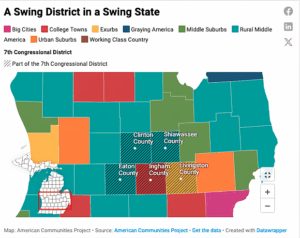
Michigan’s 7th District touches seven different counties, but five counties produced 94% of the vote in 2022 and 2024: Ingham, the College Town home of Michigan State University; Livingston, the Exurb that holds the quasi-rural suburbs of Detroit and Lansing; and the Rural Middle America counties of Clinton, Easton, and Shiawassee.
The 7th District race will likely look and feel very different in those pieces of the district and what happens in them will dictate the result in November, but also likely tell a bigger story for the nation.
Ingham, the College Town
Ingham is home to the state capital as well as to Michigan State University and its 50,000 students. That’s an important point for Democrats as younger voters tend to lean left politically. While some 2024 analyses showed President Trump made gains with younger voters, particularly younger men, subsequent polling suggests those gains may have been short-lived.
But the question with younger voters is always whether they are tuned into politics, particularly in a midterm year, when voter turnout tends to be down across the board.
In 2022, Ingham came through for then-Rep. Elissa Slotkin, when she netted about 43,000 votes from the county in a race where she defeated Barrett by about 20,000 votes. Young voters were generally not fans of President Joe Biden, but there was an added element in Slotkin’s favor. That election brought out young people voting in favor of an abortion rights amendment to the state constitution. That likely helped Slotkin boost youth voter turnout and her margin of victory.
In 2024, Tom Barrett, the Republican, won the 7th District seat by about 17,000 votes. (Slotkin vacated the district to run for and win a seat in the U.S. Senate). One key was a lower margin in Ingham. Barrett lost Ingham again, but by a slightly smaller margin of 40,000 votes.
That’s a loss of about 3,000 votes in Democratic margin in Ingham. That may not sound like a lot, but in a presidential year one might expect a bigger margin for the Democrats than in a midterm. What happened? Many young voters were unhappy with the Biden administration for a variety of reasons, including the way it handled the conflict in Israel.
If the Democratic candidate (who is not yet known) can bump the margins back up to the 43,000-vote range in a midterm year, it will be a sign that the liberal-leaning voters, especially the college students, turned out and voted Democratic.
There’s evidence college students may be more tuned into politics during Trump 2.0. Last year, the ACP heard this when talking to students at Michigan State who were dealing with the direct consequences of Trump administration policies.
Livingston County, the Exurb
Livingston is the counterpoint to Ingham. It’s well-educated with a higher median household income, but it is also reliably Republican. The county holds a lot of workers from the greater Detroit and Lansing metro areas — lots of families looking for a bigger homes and better schools.
A big jump in support among Republicans in the county was crucial to Barrett’s win in 2024.
In 2022, Barrett carried Livingston comfortably, by about 17,000 votes. But that was low compared with what might be considered normal for Livingston. One possible reason? The abortion amendment on the ballot. In 2020, the Republican incumbent carried the county by about 20,000 votes.
But in 2024, Republicans turned out in huge numbers to push Barrett to victory. He carried the county by nearly twice as much, almost 34,000 votes. Why? It seems likely that Barrett benefited from an electorate that leaned Republican and was unhappy with the nation’s economic situation, in particular.
Inflation had a massive impact on the 2024 election, but especially Exurbs. Exurbs like Livingston are socially conservative, but economics drive much of their rightward tilt, and they had reason to be testy in 2024.
That’s where 2026 could get interesting. If inflation was a big driver of the 2024 vote here, the continued problems in that department could lead to less enthusiasm among right-leaning voters in November.
Clinton, Eaton, and Shiawassee in Rural Middle America
These three counties are more rural and less populated than other parts of the district, but together they hold more votes than Ingham or Livingston. They tend to vote Republican, but they might best be thought of as Trump-surge counties.
To be clear, these counties are not all empty space. There are some suburbs of Lansing in here and other small towns, but overall, these communities are pretty rural. The vote in them can be complicated, but not when Trump is on the ballot. All three voted for Trump in 2016, 2020, and 2024. And in 2024, Tom Barrett’s vote margin from them grew by nearly five times compared with 2022.
The 2022 election shows how complicated these counties can be. Barrett narrowly captured the vote out of these three counties, winning them by a total of about 3,800 votes. He didn’t win all of them, however. Eaton county very narrowly went for Slotkin.
But 2024 was a different story. Barrett carried all three and did so decisively, by a margin of more than 18,500 votes.
The data make sense when you consider the communities. Rural Middle America is in many ways quintessential Trump country — lots of blue-collar manufacturing jobs, with fewer college degrees and lower incomes. That’s largely true in these three counties. All three are below the national average for bachelor’s degrees, a hallmark of Trump voters.
The question, of course, is what happens to the vote when Trump isn’t on the ballot, as he will not be in the fall. Can Barrett manufacture a similar surge? In a close race, he may need it to win.
Looking Forward to the Fall
Of course, no race or district can offer a truly comprehensive look at the entire midterm landscape. Candidates matter, issues matter, and Election Day is still more than nine months away. If the twists and turns of 2025 have taught us anything it is that things can change, and fast.
But what happens in Michigan’s 7th District and the pieces that compose it are likely to be telling. The American electorate isn’t a monolith. It’s made up of lots of different pieces — urban and rural, young and old, white and non-white.
What happens in the Exurbs, College Towns, and Rural Middle America will likely play a big role in what happens on November 3rd, and not just in Michigan’s 7th District but in the nation as a whole.